

HTTP semantic-convention attributes on a Lambda handler span — http.request.method, http.route, http.response.status_code — used to depend on which language you deployed in. Python's auto-instrumentation extracted them from the API Gateway event; Node.js got nothing.
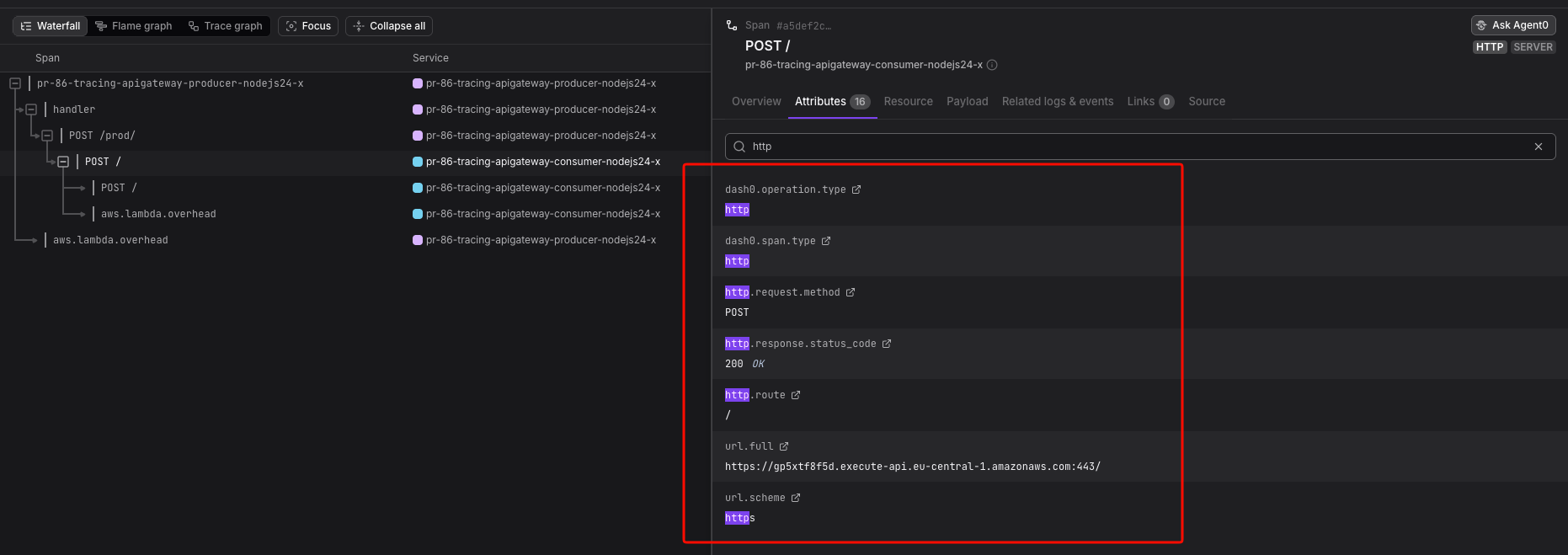
The Dash0 extension now does this parsing itself, independent of any runtime SDK. It reads the raw Lambda invocation and response payloads directly, so it works the same way for every supported runtime. If no runtime SDK is loaded to create the handler span, the extension creates that span itself and sets the attributes on it.
Covered triggers: REST API (v1) and HTTP API (v2) proxy integrations, and Lambda Function URLs. Each handler span gets http.request.method, url.path, url.scheme, http.route, server.address, server.port, client.address, network.protocol.version, and http.response.status_code attached automatically — no code changes required.
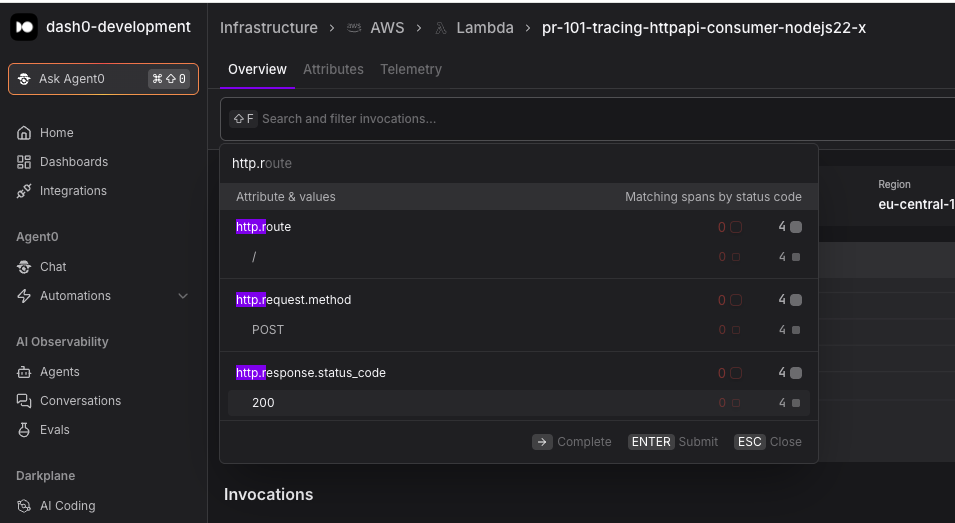
Because these are ordinary span attributes, you can filter and group on them right away, both in the Trace Explorer and in the invocations view of a Lambda function. Filter by http.response.status_code to pull up only the failed invocations, or group by http.route to see which endpoint is responsible for them. This makes triage faster: a noisy function narrows down to one endpoint and one status code without you touching any code.
In order to use this new feature, upgrade to the dash0 lambda extension version 23 or higher.
Read the docs for the full attribute list, the supported triggers, and the optional span renaming and header capture settings: https://www.dash0.com/docs/dash0/infrastructure/aws/aws-lambda/trace-lambda-functions