


Not every question deserves the same model. Reading one service's error logs is cheap work. Chasing a symptom across four services during an incident is not, and answering it with a model that cannot hold the whole picture wastes more than credits. Until now Agent0 made that call for you, on every run, with no way to change it.
Agent0 now offers four levels, Light, Standard, Advanced, and Premium, plus a reasoning effort that controls how long the model thinks before it answers. Pick one in the Chat prompt toolbar, store one on an automation, name one on an MCP runTask call, or set your own default for each of those under Settings → Agent0. Slack answers say which level and effort they ran with and link to the Slack default in settings. A level names a capability step rather than a model, so Dash0 keeps the model behind each one current and your setting keeps meaning what you chose. Credits are charged on what a turn consumed, priced at the model that served it, so the cost of a level is the cost of the run and not a flat surcharge. Each answer reports the level and effort it ran with. See Model Selection.
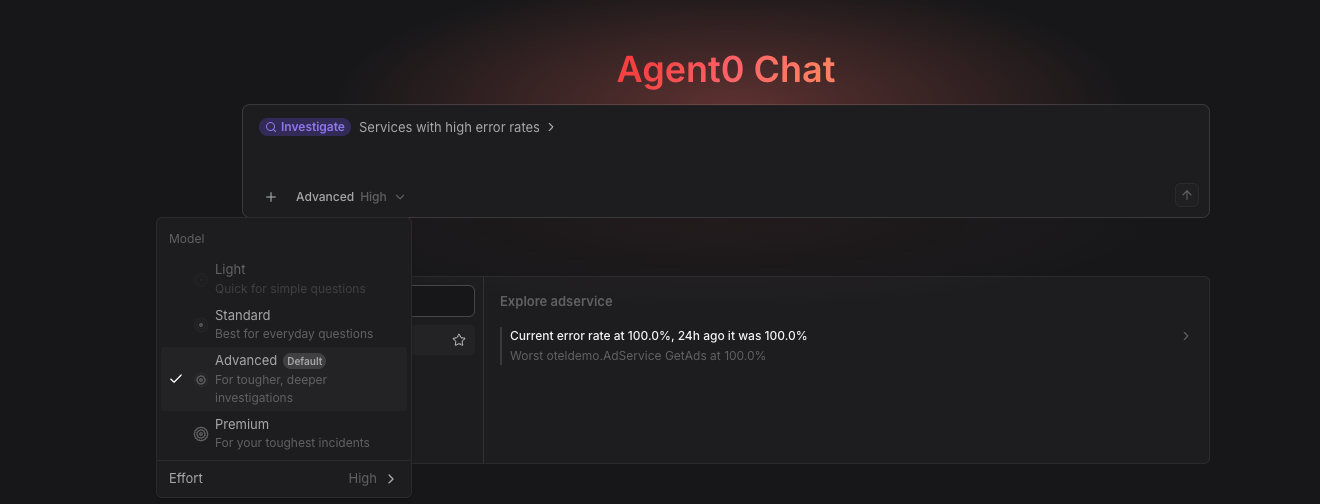
One thing to know before your next invoice. Agent0's default level is now Advanced, up from the single model every run used before. It answers harder questions on the first pass, and it uses more credits per turn than the old default did. If your work is mostly routine triage, set your Agent0 Chat and Automations defaults to Light or Standard under Settings → Agent0 and keep the old cost profile. Every run shows its real credit cost, and a monthly credit budget still caps the total.
Not every level runs in every region. A level Dash0 cannot serve for your organization is disabled in the picker with the reason.