


viadee is an independent IT consultancy based in Germany, founded in 1994. Working across software development, cloud platforms, data and AI, IT security, and quality engineering, the company serves clients in insurance, the public sector, banking, and energy.
viadee is technology agnostic by design. The team chooses the tools that fit each client, not the other way around. For Max, IT Consultant and Cloud Engineer, and Constanze Klaar, Senior Consultant and Software Architect, observability had to work the same way.
The Challenge: Every Project Started from Scratch
Before Dash0, viadee relied primarily on self-hosted Grafana and Prometheus. The foundation was solid, but the approach was decentralized.
“Every team had to manage its own setup,” Constanze says. “Everyone had their own dashboards and alert setups, and for every development team there was a lot of work involved in setting up the observability tooling.”
The team also reached a limit in what the existing setup could reveal.
“We had logs and metrics before, but they were really isolated,” Constanze says. “Without tracing, there were situations where we came to a limit when something was failing in production.”
Across viadee’s client base, that complexity multiplies quickly.
Every client has a different setup, different technology stack, and different cloud providers. If something breaks in production, we need to follow the path of the request across boundaries without changing tools all the time. It makes a difference whether we can find an issue in ten minutes or need three hours.
The Decision: OpenTelemetry-Native from the Ground Up
OpenTelemetry was at the top of viadee’s requirements.
“We instrument once and can connect it to virtually any backend,” Max says. “That is really important because of the range of our client environments.”
Dash0 stood out because it was OpenTelemetry-native from the ground up, not retrofitted to support it. Pricing was transparent: viadee pays per telemetry signal, rather than per seat or gigabytes with hidden multipliers. The relationship was also different from day one.
“We set up a shared Slack channel early on,” Max says. “Any time we had a question, we sent a message and received a real answer instead of a ticket number. That made the decision very easy.”
The Rollout: Meaningful Traces in One to Two Days
viadee expected onboarding to take much longer.
“Getting OpenTelemetry data into Dash0 was surprisingly straightforward, especially for Kubernetes-based setups,” Max says. “We were able to collect meaningful traces within one or two days.”
viadee started with its own cloud platforms, then brought Dash0 into client engagements once the team trusted it in real operating conditions.
“When we recommend Dash0 to our clients, we are speaking from experience and not from data sheets,” Max says.
The Impact: From Searching to Analyzing
The biggest shift has been in how viadee investigates issues.
“The biggest shift is that we spend less time answering the question, ‘Where do I even look?’” Max says. “We can spend more time understanding what actually happened.”
Instead of copying IDs between tabs or correlating timestamps manually, the team can move from a log entry to related traces and metrics without leaving Dash0.
Agent0 pushed that shift further.
Agent0 is one of the biggest time savers we have found in Dash0. It already analyzes what is going on and takes me to the place that actually matters. The shift from searching for the problem to analyzing what Agent0 has already found is a completely different way of working.
viadee has also connected Dash0’s MCP integration to its internal GitHub Copilot workflows, exploring how observability context can help create fixes and pull requests. Dash0’s newer integrated agentic workflow is not yet in production at viadee, but it is firmly on the roadmap.
Where Integrated Observability Made the Difference
Two examples show what Dash0 and OpenTelemetry have unlocked.
When viadee’s internal GPT application, built on LiteLLM, experienced request failures that were difficult to reproduce, distributed tracing allowed the team to follow the request through the different LLM layers and identify the root cause.
The second example involved a SaaS portfolio management platform for pension funds, where strict data requirements had made external observability seem impossible.
Working with Dash0 and OpenTelemetry, the team found an architecture that filters sensitive data before it leaves the environment while retaining the telemetry needed for investigations.
“With Dash0 and the OpenTelemetry stack, we found an architecture where we could filter the sensitive data but still have observability in Dash0,” Constanze says.
Dash0’s filtering capabilities and Spam Filters also help viadee control costs across projects with different data volumes, reducing unnecessary telemetry without sacrificing the signals teams need.
From Managing Observability to Using It
Configuration as code helps viadee create a repeatable baseline that can be versioned and reused across teams and client projects. viadee has now introduced Dash0 to around 30 to 40 colleagues, and the feedback has been consistently positive.
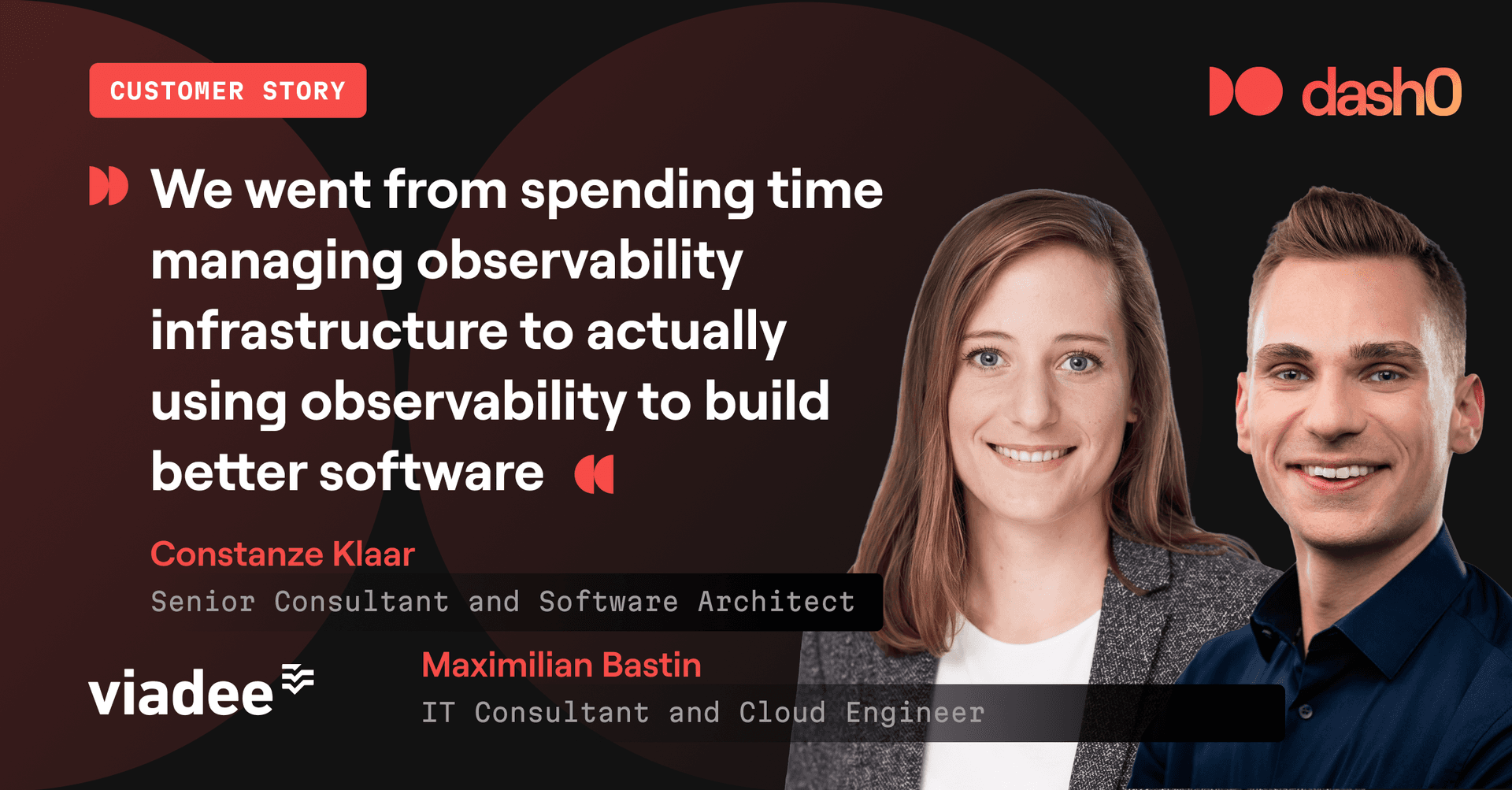
We went from spending time managing observability infrastructure to actually using observability to build better software. That shift makes a real difference both for our own platforms and for our customers.
The relationship has mattered as much as the product.
“Working with Dash0 as a partner rather than a vendor has shaped how we see observability,” Max says. “We can pick up the phone, have a technical conversation, and know that the feedback we give can influence where the product goes. That kind of relationship is very rare.”



