
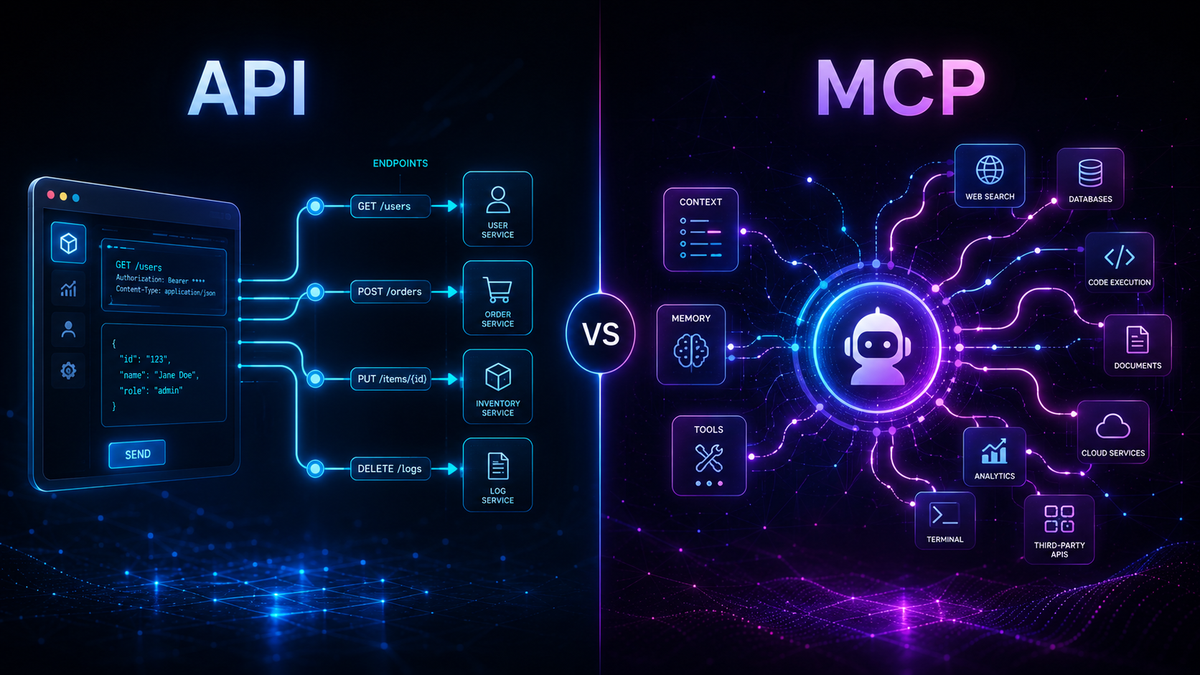
The Model Context Protocol (MCP) and APIs get compared as if you have to pick one. You don't. An API is a contract between two pieces of software: fixed endpoints, defined shapes, your code deciding what to call and when. MCP sits a layer above that, exposing capabilities to an LLM so the model decides which tools to invoke at runtime. They serve different consumers. In practice you usually run both.
Why APIs alone don't fit models
A traditional API is clean and predictable. You define an endpoint, send a structured request, get a structured response. That works perfectly when one program is talking to another, because both sides already know what to expect.
Models break that assumption. A model working through a real task rarely hits a single endpoint. It might chain ten of them, interpret unstructured data along the way, and decide what to call next based on what came back. It doesn't just need to reach a tool. It needs to understand what the tool is for.
A plain API is a locked cabinet. You need to know which drawer to open and the exact shape of the key. A model shows up without labels on the drawers. Unless you spell out which function to call and which parameters to pass, it doesn't know, which in an API-only world means hardcoding the calling logic and re-explaining it in prompts every time something changes.
Who's in control
With an API, your application is in control. You read the docs, write code against POST /orders, parse the response, handle the errors, decide what happens next. The API doesn't know or care that an AI is involved.
With MCP, the model is in control. An MCP server advertises a set of tools and the LLM picks which to call based on the user's request. The logic of what to call and when moves out of your app code and into the model's reasoning. Tell an assistant "check my error rate and open a ticket if it spiked" and the model discovers the metrics tool and the ticketing tool, calls them in order, carries context between them. Nobody wrote that sequence.
APIs are for applications. MCP is for LLMs. The client of an API is another program. The client of an MCP server is the model, and that shift changes how you design the whole integration.
A concrete example
Say you're building an agent to manage support tickets, with access to Gmail, Notion, and Jira.
The API-only version: custom integration code for each service, three times over. Pagination, auth tokens, rate limits, error handling, all bespoke. Then you teach the model through lengthy prompts: file a Jira ticket by calling this endpoint with these fields, reply to an email by sending Gmail this payload. Every change touches code and prompts.
The MCP version: each service exposes an MCP-compatible interface. The model discovers the available tools and works out which to use. You give it context, not a script. The difference is handing the model a toolbox versus making it memorize how each tool works.
Four mechanical differences worth understanding
Discovery
A REST API doesn't describe itself. You need docs to know what endpoints exist and what they take. An MCP server is queryable at runtime. Ask what tools are available and you get back a machine-readable list of functions with their inputs, outputs, and descriptions in JSON schemas. The interface is the documentation. Add a new tool and clients can use it immediately, no code change required.
State
REST is stateless. Each request stands alone, so the client re-sends context every time: auth tokens, filters, whatever the endpoint needs. MCP maintains stateful sessions over JSON-RPC 2.0. When a model runs through several actions, it knows they're part of the same task, which is how multi-step workflows hold together without you threading state through every request by hand.
Standardization
Every REST API is its own snowflake. One uses OAuth, the next API keys, one returns XML, another JSON. MCP normalizes this: once a client speaks the protocol it can talk to any MCP server. Anthropic calls the underlying issue the M×N problem. M models and N tools requires M×N custom connectors. MCP collapses that to M+N, because each tool implements the protocol once. HTTP did the same thing for the web in the nineties. Before it, every service ran its own protocol. After it, they were interoperable.
Invocation model
REST maps HTTP methods to resources. MCP exposes three primitives: tools (executable functions), resources (data passed to the model as context, like logs or file contents), and prompts (reusable templates). Not everything belongs as a callable tool, so the distinction matters when you're designing a server. The MCP spec covers this in detail.
MCP doesn't replace APIs
Most MCP servers call REST APIs internally. The API still does the actual work: querying the database, hitting the payment provider. MCP replaces the middleware between the model and the API, translating your existing endpoints into something the model can reason about.
The trap people fall into is wrapping an existing API one-to-one in an MCP server. It feels efficient. It isn't. Every tool definition and response spends tokens from the model's context budget. Return 50 fields when the model needs 3 and you're burning money. The worse problem is context rot: the model starts degrading because it's drowning in data it doesn't need. Design MCP servers for what the model actually requires, not as thin wrappers over your API surface.
When to use which
A plain API is the right choice when a developer is writing code against a known service with fixed calling logic. SaaS integrations, backend-to-backend communication, web apps. MCP adds nothing there.
MCP is the right choice when an AI agent needs to discover and orchestrate tools at runtime, especially across multiple services where context has to survive several steps. If the sequence of actions isn't known until the user asks, MCP is what lets the model work it out.
And both covers most real AI feature work. Your APIs handle operations; MCP makes them accessible to the model. One side benefit worth noting: a single MCP integration surface is easier to audit than several independent API integrations each running their own auth and logging.
Permissions: the part people skip
Letting a model choose its own call path introduces risk a fixed integration doesn't have. Without explicit permission boundaries, a model can send an email, delete a file, or trigger a destructive database operation it was never supposed to touch. APIs handle this through auth keys and rate limits. MCP addresses it through defined capabilities, scopes, and authentication methods in the spec, and this area is improving fast. Don't assume the defaults keep you safe. Design permission boundaries deliberately.
Tracing agent failures
When something breaks in an MCP-driven workflow, reproducing it is harder than a standard API failure. The call path was chosen at runtime by the model. To understand what went wrong you need to see what the model saw, what it decided, which tool it called, and what the downstream API returned, ideally in a single trace rather than stitched together from separate logs.
Final thoughts
MCP and APIs aren't competing technologies. APIs are the foundation. MCP is the layer that makes them usable by models. Build the right thing at the right layer and you get agents that can reason over your tools without you hardcoding every possible action.
The observability challenge that comes with this is real. Because the model chooses the call path at runtime, a failure in an MCP-driven workflow looks nothing like a standard API error. Dash0's OpenTelemetry-native observability captures distributed traces, infrastructure monitoring, and logs in one place, so you can follow a request from the model's tool invocation through every API call it triggered and see exactly where things broke.
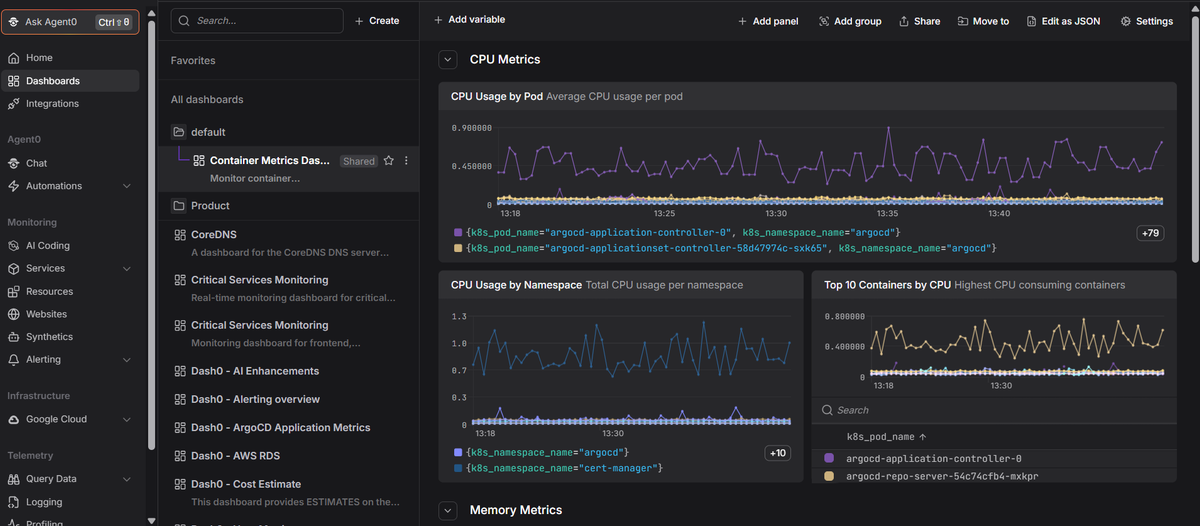 Start a free trial to trace your AI agent and API calls in a single view. No credit card required.