Traefik is a widely adopted ingress controller and edge router in the Kubernetes ecosystem, known for its dynamic configuration model, broad protocol support, and strong community momentum. Unlike many ingress controllers that build on Envoy, Traefik is implemented in Go and follows a different architectural approach to request handling and telemetry emission. That difference is reflected clearly in how Traefik integrates with OpenTelemetry.
Ingress controllers sit at a critical boundary in Kubernetes environments. They handle incoming traffic, apply routing and security policies, and often represent the first observable hop when diagnosing user-facing latency or failures. Because of this position, the quality, structure, and consistency of telemetry emitted by an ingress controller can have an outsized impact on operational visibility.
Recent developments in the Kubernetes ecosystem further underline the relevance of ingress observability. With the announcement that ingress-nginx is being retired from the Kubernetes project, many teams are reassessing their ingress choices and evaluating alternatives such as Gateway API–based implementations, and other data planes. In that context, understanding how ingress controllers integrate with OpenTelemetry becomes an important input when making long-term platform decisions.
This post looks at how Traefik integrates with OpenTelemetry in practice, using a proposed OpenTelemetry support maturity model to describe how telemetry is produced, where it is OpenTelemetry-native, and where it depends on downstream processing.
How we evaluate OpenTelemetry support
OpenTelemetry support rarely evolves uniformly across all signals. Tracing, logging, and metrics are often shaped by different historical decisions, ecosystem norms, and backend assumptions. In ingress controllers, this is especially visible: metrics were traditionally exposed for scraping, logging formats evolved independently, and tracing was often added later.
To make these differences easier to reason about, I’ll use a proposed maturity model that describes OpenTelemetry support across a set of dimensions - not as a scorecard, but as a way to describe where alignment happens and where it depends on the pipeline:
- Integration Surface – how users connect the project to observability pipelines
- Semantic Conventions – how consistently telemetry meaning aligns with OpenTelemetry conventions
- Resource Attributes & Configuration – how identity and configuration behave across environments
- Trace Modeling & Context Propagation – how traces are structured and how context flows
- Multi-Signal Observability – how traces, metrics, and logs work together in practice
- Audience & Signal Quality – who the telemetry is designed for and how usable it is by default
- Stability & Change Management – how telemetry evolves once users depend on it
Each dimension is described independently. Projects often land at different maturity levels across different dimensions, and that is expected. Level 3 in this model represents OpenTelemetry-optimized behavior, where OTLP is treated as the primary interface and telemetry design is intentional rather than incidental from the perspective of platform operators.
The maturity model itself is still evolving and is being discussed openly in the OpenTelemetry community. This post should be read as an exploration of how Traefik’s OpenTelemetry integration behaves in practice, using the maturity model as a way to describe integration patterns - not as a definitive or final judgment.
Evaluation environment
The evaluation environment is intentionally simple and reflects a common local development workflow. Traefik runs in a local kind cluster and is configured as an ingress controller using Kubernetes-native resources. OpenTelemetry is enabled using Traefik’s built-in exporters for tracing, logging, and metrics.
Request traffic is generated from the local machine to exercise ingress behavior. A small backend service runs inside the cluster to verify that trace context created or propagated by Traefik is preserved as requests flow downstream. This allows ingress-level behavior and downstream trace continuity to be observed without introducing unnecessary complexity.
An OpenTelemetry Collector acts as the central alignment point for all telemetry. Traefik exports traces, logs, and metrics via OTLP. The Collector receives all three signals, applies standard enrichment, and forwards them to Dash0 as the observability backend used in this evaluation.
The same setup can alternatively route telemetry to an open source stack comprised of Prometheus (metrics), Jaeger (traces), and OpenSearch (logs). The observations below focus on emitted telemetry structure and integration behavior rather than backend-specific capabilities.
The purpose of this environment is not to simulate production load, but to observe how Traefik’s telemetry behaves once enabled and how signals align when processed through a standard OpenTelemetry pipeline.
Tracing at the ingress
Tracing is an intentional and well-integrated aspect of Traefik’s OpenTelemetry support. Traefik emits spans via OTLP, making OpenTelemetry the primary export path for tracing rather than a secondary integration layered on top of an existing system.
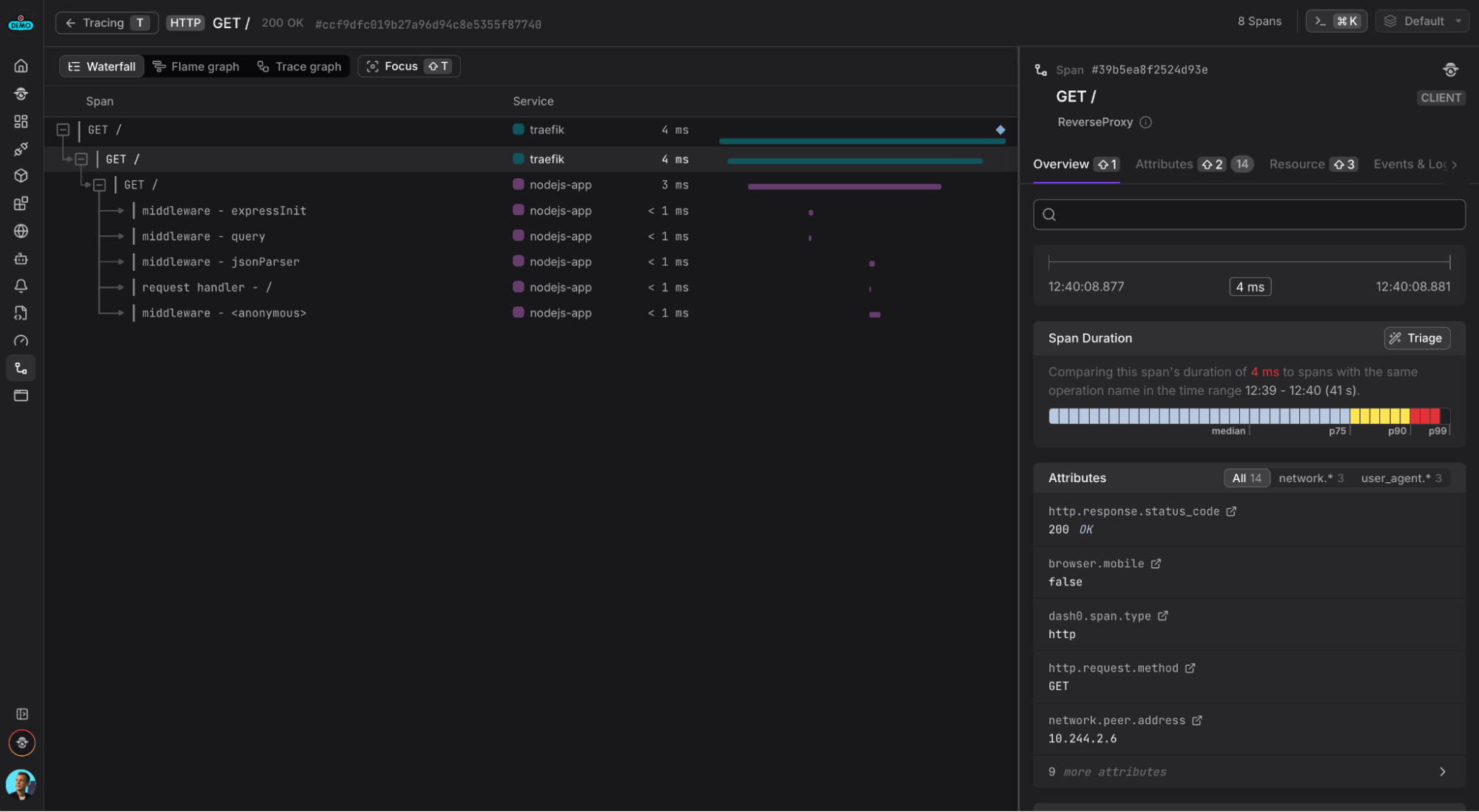
Trace context propagation follows the W3C Trace Context specification. Incoming trace context is preserved, and when no upstream context is present, Traefik correctly starts a new trace at the ingress boundary. Every request entering the cluster gets a well-defined trace root.
Span structure reflects Traefik’s internal request handling model. Traces represent synchronous request flows through the ingress layer with predictable parent–child relationships. While span depth and naming are relatively simple, the resulting traces are consistent and easy to interpret.
For platform teams operating shared ingress controllers, this predictability is valuable. Traces clearly show ingress latency, routing behavior, and downstream propagation without introducing excessive noise or application-specific semantics.
Access logs and trace correlation
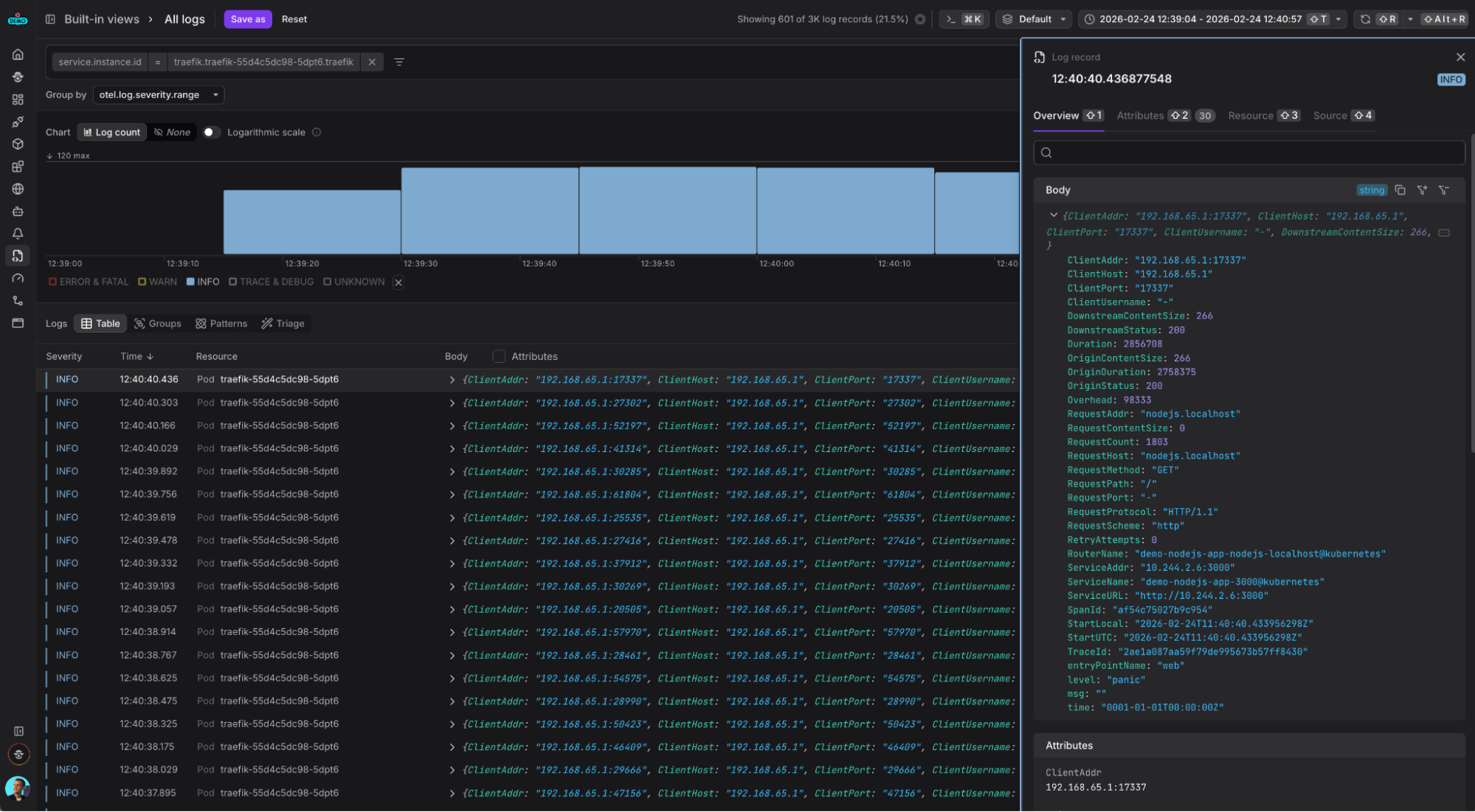
Traefik can export structured access logs via OTLP when explicitly enabled, providing an OpenTelemetry-compatible export option alongside its existing JSON log output. This OTLP-based log export is currently marked as experimental and must be opted into through configuration, but it signals the project’s direction toward integrating more closely with OpenTelemetry-based pipelines. Log records include detailed HTTP request and response information and can be ingested directly by OpenTelemetry Collectors, with downstream processing used to enrich context and normalize fields where required.
Traefik logs are correlated with tracing data: Trace context, i.e., the identifiers of the trace and the span being recorded as the log was produced, are embedded directly in the OTLP log records emitted by Traefik. This means logs are natively correlated with traces at the source, without requiring parsing, extraction, or reconstruction of trace context downstream. From a maturity perspective, this significantly reduces pipeline complexity and lowers the operational cost of achieving cross-signal correlation. Compared to approaches that rely on text logs or post-hoc correlation logic, this significantly reduces configuration toil, operational complexity and the risk of correlation errors.
At the same time, Traefik’s access logs use a custom log schema rather than OpenTelemetry semantic conventions. Field names such as DownstreamStatus, RequestMethod, and RequestPath are expressive and internally consistent, but they do not align with standardized OpenTelemetry attribute names, nor with their customary naming scheme.
Since Traefik automatically sets the k8s.pod.uid attribute, Kubernetes resource attributes such as pod, deployment, and namespace identifiers are easily added by the OpenTelemetry Collector using the standard k8sattributes processor without having to rely on brittle correlations like the connection ip, which notoriously does not work when service meshes are used. This separation of concerns aligns with common OpenTelemetry deployment patterns: Traefik provides clean, correlated ingress-level telemetry, while the Collector enriches it with environment-specific context and, where needed, normalizes log fields for broader interoperability.
Metrics: OpenTelemetry-native export
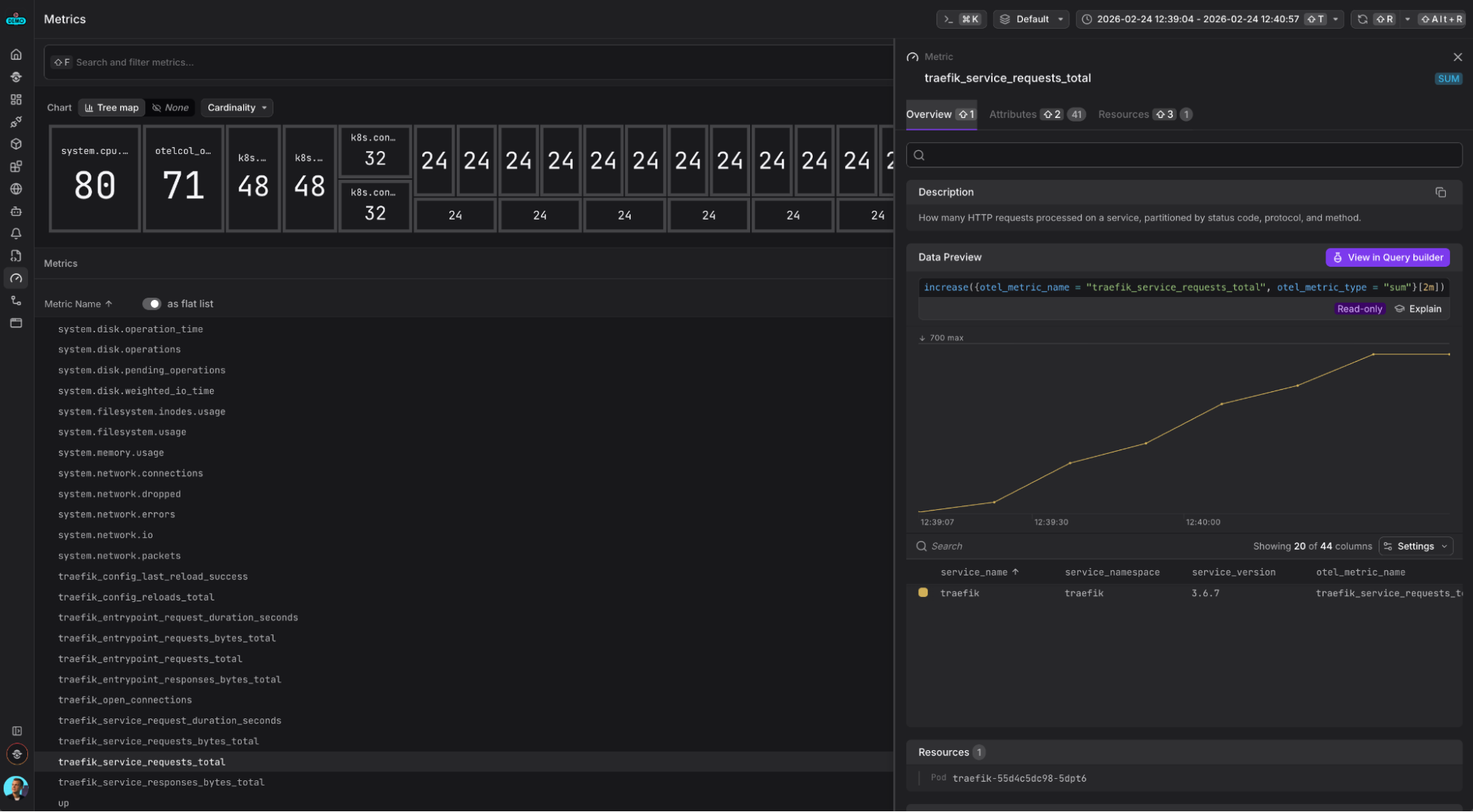
Traefik exports metrics using OTLP, treating OpenTelemetry as the primary integration surface for metrics alongside traces and logs. Metrics are pushed directly to the OpenTelemetry Collector, avoiding scrape-based configuration and keeping telemetry export consistent across all signals.
This OTLP-first approach provides several advantages. It establishes a vendor-neutral export contract, simplifies configuration by using a single protocol across signals, and makes it possible to route metrics to different backends without changing Traefik’s configuration. From the project’s perspective, metrics are expressed as OpenTelemetry metrics.
By treating OTLP as the primary metrics interface and delegating storage concerns to the pipeline, Traefik enables flexible, future-proof metrics integration while keeping observability configuration consistent across signals.
Summary view: Traefik OpenTelemetry maturity
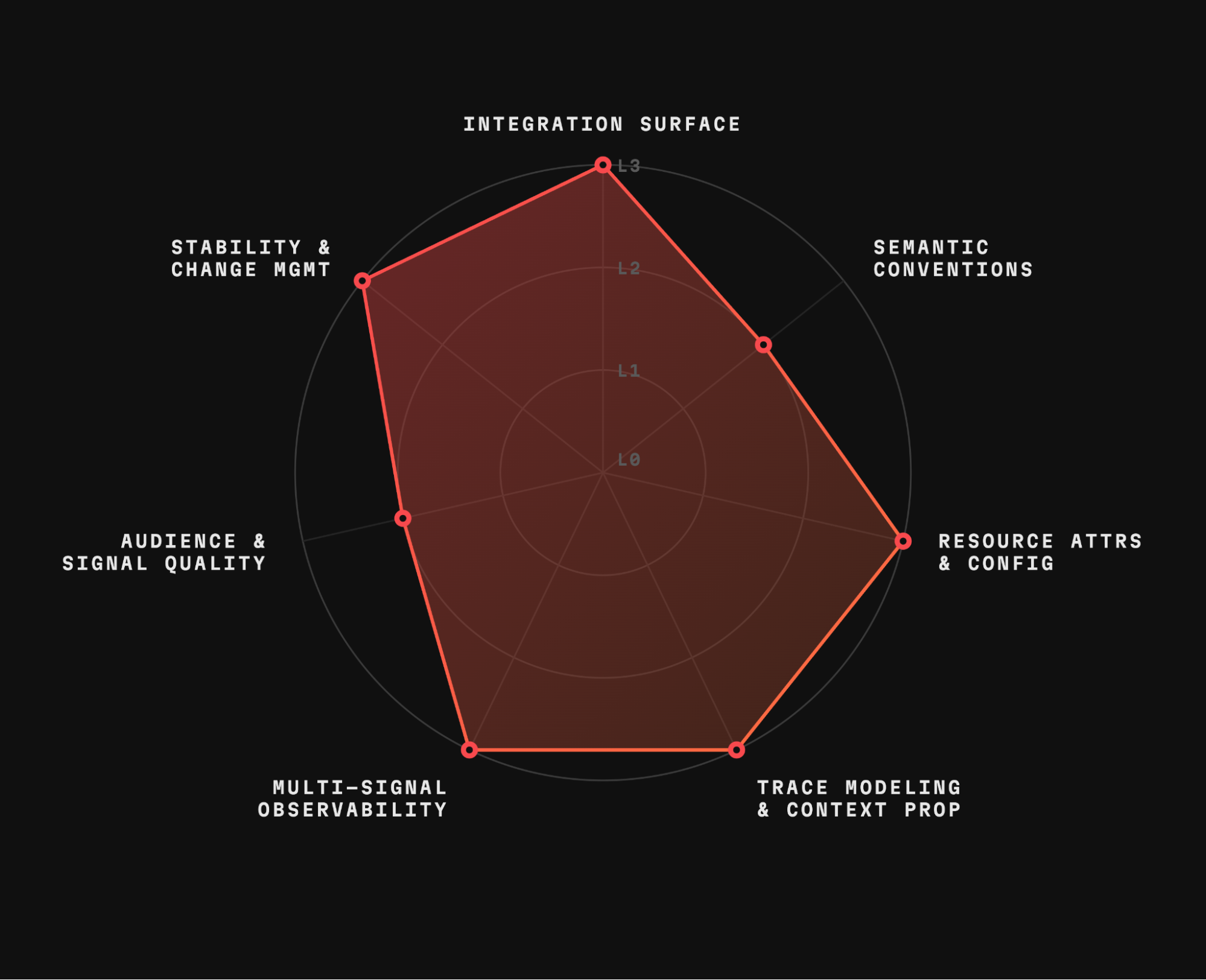
Before diving into each dimension in detail, it is useful to step back and considerhow Traefik’s OpenTelemetry support shapes up across the maturity model as a whole.
Each dimension is described along a progression across four qualitative levels of OpenTelemetry maturity, where higher values indicate deeper and more intentional OpenTelemetry integration. The purpose of this analysis is not to produce a single aggregate score, but to show where the experience is already strong and where you are more likely to encounter friction when operating Traefik as a shared ingress layer.
In Traefik’s case, the overall shape reflects a project that treats OpenTelemetry as a first-class interface across all three signals. Traces, logs, and metrics are exported via OTLP, with environment-specific context added through standard Collector enrichment rather than source-level instrumentation.
Dimension-by-dimension analysis
The sections that follow walk through each dimension in turn, grounding this high-level view in concrete observations from the evaluation environment.
Integration surface
From an integration perspective, Traefik presents a clean and consistent model. All three telemetry signals are exported using OTLP, and configuration is straightforward and Kubernetes-native.
The OpenTelemetry Collector plays a central role, but primarily as an enrichment and routing layer rather than as a workaround for missing source-level capabilities. This results in a relatively simple and portable integration surface.
Semantic conventions
Traefik’s telemetry generally follows established conventions, but alignment with current OpenTelemetry semantic conventions is uneven. HTTP semantics are clear, but log field names reflect Traefik’s internal schema rather than standardized OpenTelemetry attributes. Aligning Traefik’s custom attributes more closely with OpenTelemetry semantic conventions - and publishing them using tools such as OTel Weaver - would further improve interoperability with generic OpenTelemetry tooling.
This does not prevent effective observability, but it does require transformation if logs are to be used with generic OpenTelemetry dashboards and tools.
Resource attributes & configuration
Traefik emits a stable service identity and behaves predictably across environments. Kubernetes resource attributes are not fully emitted at the source, but are consistently added by the OpenTelemetry Collector using standard processors.
This pattern is widely used in OpenTelemetry deployments and does not limit observability in practice. Runtime customization of resource identity is possible through standard pipeline configuration, even if not treated as an explicit source-level contract.
Trace modeling & context propagation
Trace modeling in Traefik is deliberate and focused on synchronous HTTP request flows. Context propagation follows open standards and behaves reliably across ingress and downstream services.
More advanced propagation scenarios or domain-specific trace semantics are not addressed by default, but Traefik’s extensibility leaves room for such behavior to be introduced if needed.
Multi-signal observability
Traefik emits traces, logs, and metrics using a consistent OTLP-first model. This uniform export mechanism reduces pipeline complexity and avoids split-brain observability setups.
Correlation between signals is native for traces and logs, with infrastructure context added through standard enrichment. Metrics integrate cleanly into the same pipeline, even when stored in a backend that uses a different internal representation.
Audience & signal quality
Traefik’s telemetry is well suited for platform and infrastructure teams operating shared ingress controllers. Signals focus on routing behavior, latency, response codes, and backend interaction, supporting common debugging and operational workflows without requiring extensive customization.
Stability & change management
Traefik is a mature project with a predictable release cadence. Telemetry behavior is stable in practice, though not treated as an explicit contract with versioned guarantees.
You can rely on consistent behavior across releases, but clearer documentation of telemetry stability and evolution would further strengthen long-term confidence. While Traefik’s telemetry is highly usable for its intended audience, it does not yet reach the level of being fully OpenTelemetry-optimized by default. Access logs use a custom schema rather than OpenTelemetry semantic conventions, and some signals require familiarity with Traefik-specific field names or Collector-level transformation to integrate seamlessly with generic OpenTelemetry tooling.
As a result, the telemetry is immediately valuable for platform and infrastructure teams who understand ingress behavior and OpenTelemetry pipelines, but it is not yet self-describing or semantically standardized enough to be consumed universally without interpretation. Reaching that level - where signals are broadly usable out of the box across tools and audiences - is what distinguishes Level 3 in this dimension.
Where Traefik lands
Taken together, Traefik’s OpenTelemetry support reflects a project that is close to OpenTelemetry-optimized. By treating OTLP as the primary interface across all signals and relying on standard pipeline enrichment, Traefik enables flexible, interoperable observability with relatively low operational friction.
Final thoughts
Traefik demonstrates how adopting OpenTelemetry as a first-class export mechanism across traces, logs, and metrics can simplify observability pipelines and future-proof telemetry design.
At the same time, this evaluation reinforces the importance of the OpenTelemetry Collector as an architectural component. For Traefik, the Collector is where enrichment, optional normalization, and backend routing occur, turning clean OTLP signals into actionable observability.
The maturity model used here is intended to make those design choices visible and easier to discuss, and to support ongoing collaboration as ingress controllers and OpenTelemetry continue to evolve together.
This should be read as an exploration of how Traefik’s OpenTelemetry integration behaves in practice, and as a contribution to a broader discussion about how we describe OpenTelemetry support across the ecosystem.