Istio is one of the most widely deployed service meshes in the Kubernetes ecosystem. While it is often associated with sidecarless-based traffic management, Istio’s gateway components play a distinct and increasingly important role as the entry point into service mesh–enabled environments.
Gateways sit at a critical boundary. They terminate incoming traffic, apply routing and security policies, and often represent the first place where user-facing latency or failures can be observed. As OpenTelemetry has become the de facto standard for cloud-native observability, you increasingly expect gateways to integrate cleanly into OpenTelemetry-based pipelines - to do so with predictable semantics, consistent identity, and usable defaults across traces, logs, and metrics.
Recent developments in the Kubernetes ecosystem further underline the relevance of this evaluation. With the announced retirement of ingress-nginx from the Kubernetes project, many teams are reassessing their ingress strategy and evaluating alternatives such as Gateway API–based implementations, Envoy-based gateways, and service mesh gateways. In that context, understanding how Istio Gateway integrates with OpenTelemetry becomes an important input into long-term platform decisions.
This post looks at how Istio Gateway integrates with OpenTelemetry in practice, using a proposed OpenTelemetry support maturity model to describe how telemetry is produced, where it aligns well with current OpenTelemetry expectations, and where historical design choices still shape the integration experience. The model is under active discussion in the OpenTelemetry community and is intended to surface integration characteristics rather than produce a definitive score. Rather than questioning whether Istio’s telemetry is usable in practice - it clearly is, and at large scale - the goal here is to understand how its emitted signals align with current OpenTelemetry conventions and expectations.
How we evaluate OpenTelemetry support
OpenTelemetry support rarely evolves uniformly across all signals. Tracing, logging, and metrics are often shaped by different historical decisions, ecosystem norms, and architectural constraints. In service meshes and gateways, this is especially visible: metrics were traditionally exposed for scraping, logging formats evolved independently, and tracing was often introduced incrementally through proxy-level instrumentation.
To make these differences easier to reason about, I’ll use a proposed maturity model that describes OpenTelemetry support across a set of dimensions - not as a scorecard, but as a way to make integration patterns and trade-offs easier to reason about:
- Integration Surface – how users connect the project to observability pipelines
- Semantic Conventions – how consistently telemetry meaning aligns with OpenTelemetry conventions
- Resource Attributes & Configuration – how identity and configuration behave across environments
- Trace Modeling & Context Propagation – how traces are structured and how context flows
- Multi-Signal Observability – how traces, metrics, and logs work together in practice
- Audience & Signal Quality – who the telemetry is designed for and how usable it is by default
- Stability & Change Management – how telemetry evolves once users depend on it
Each dimension is described independently. Projects often land at different maturity levels across different dimensions, and that is expected. The maturity model is intended to surface trade-offs and friction points rather than collapse everything into a single score.
The maturity model itself is still evolving and is being discussed openly in the OpenTelemetry community. This post should be read as an exploration of how Istio Gateway’s OpenTelemetry integration behaves in practice, using the model to describe integration patterns rather than as a definitive or final judgment of Istio’s observability design.
Evaluation environment
The evaluation environment reflects a common local development workflow.
Istio Gateway runs in a local kind Kubernetes cluster using Istio Gateway and VirtualService resources. OpenTelemetry support is enabled through Envoy’s native tracing capabilities and Istio’s configuration mechanisms.
Request traffic is generated from the local machine to exercise gateway behavior. A small backend service runs inside the cluster to verify that trace context created or propagated by Istio Gateway is preserved as requests flow downstream.
An OpenTelemetry Collector acts as the central alignment point for all telemetry. Traces are exported from Envoy via OTLP. Metrics are collected through Prometheus-style scraping, and logs are ingested and enriched through the Collector pipeline. Signals are routed to Dash0 as the observability backend used in this evaluation.
The choice of backend does not affect the observations below, which focus on emitted telemetry structure and integration behavior rather than visualization features. If you prefer open source backends, the same Collector pipelines can route traces, metrics, and logs to separate tools such as Jaeger, Prometheus, and OpenSearch.
The goal is not to simulate production load, but to observe how Istio Gateway’s telemetry behaves once enabled and how signals align when processed through an OpenTelemetry pipeline.
Tracing at the gateway
Tracing is a mature and reliable aspect of Istio Gateway’s OpenTelemetry integration. Envoy spans are emitted using OpenTelemetry-compatible mechanisms, and Istio treats tracing as a first-class concern within the data plane.
Trace context propagation follows the W3C Trace Context specification. Incoming trace context is preserved, and when no upstream context is present, Istio Gateway starts a new trace at the ingress boundary. Every request entering the mesh gets a well-defined trace root.
Span structure reflects Envoy’s execution model and focuses on synchronous request handling. Parent–child relationships between gateway spans and downstream service spans are preserved, making it straightforward to reason about how requests flow through the gateway and into the mesh.
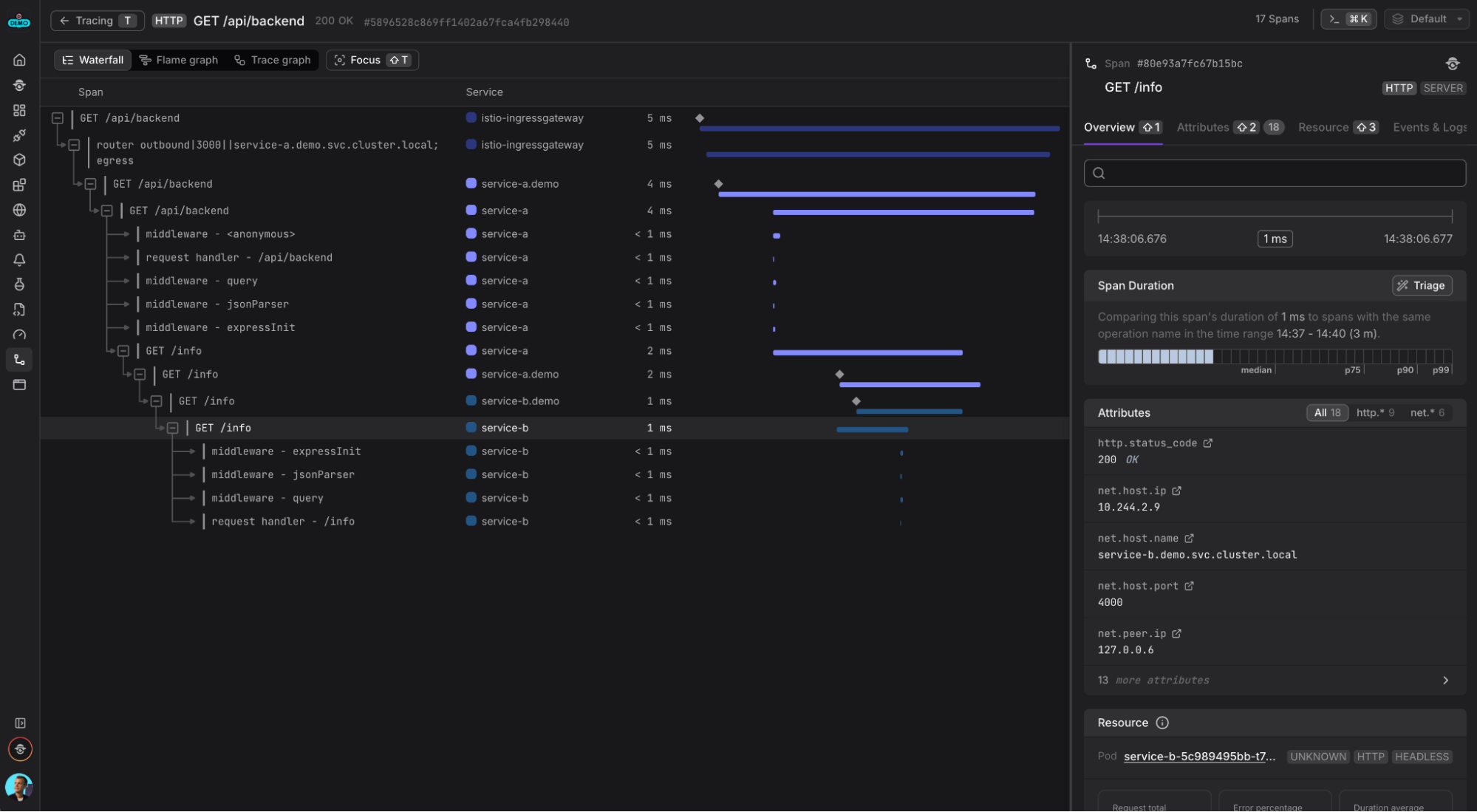
However, Istio currently relies on deprecated HTTP semantic conventions from pre-1.23 OpenTelemetry specifications. Attributes such as http.method, http.status_code, and http.url have been superseded by stable alternatives like http.request.method, http.response.status_code, and url.full. In addition, some attributes are emitted with incorrect types - for example, HTTP status codes are sent as strings rather than integers.
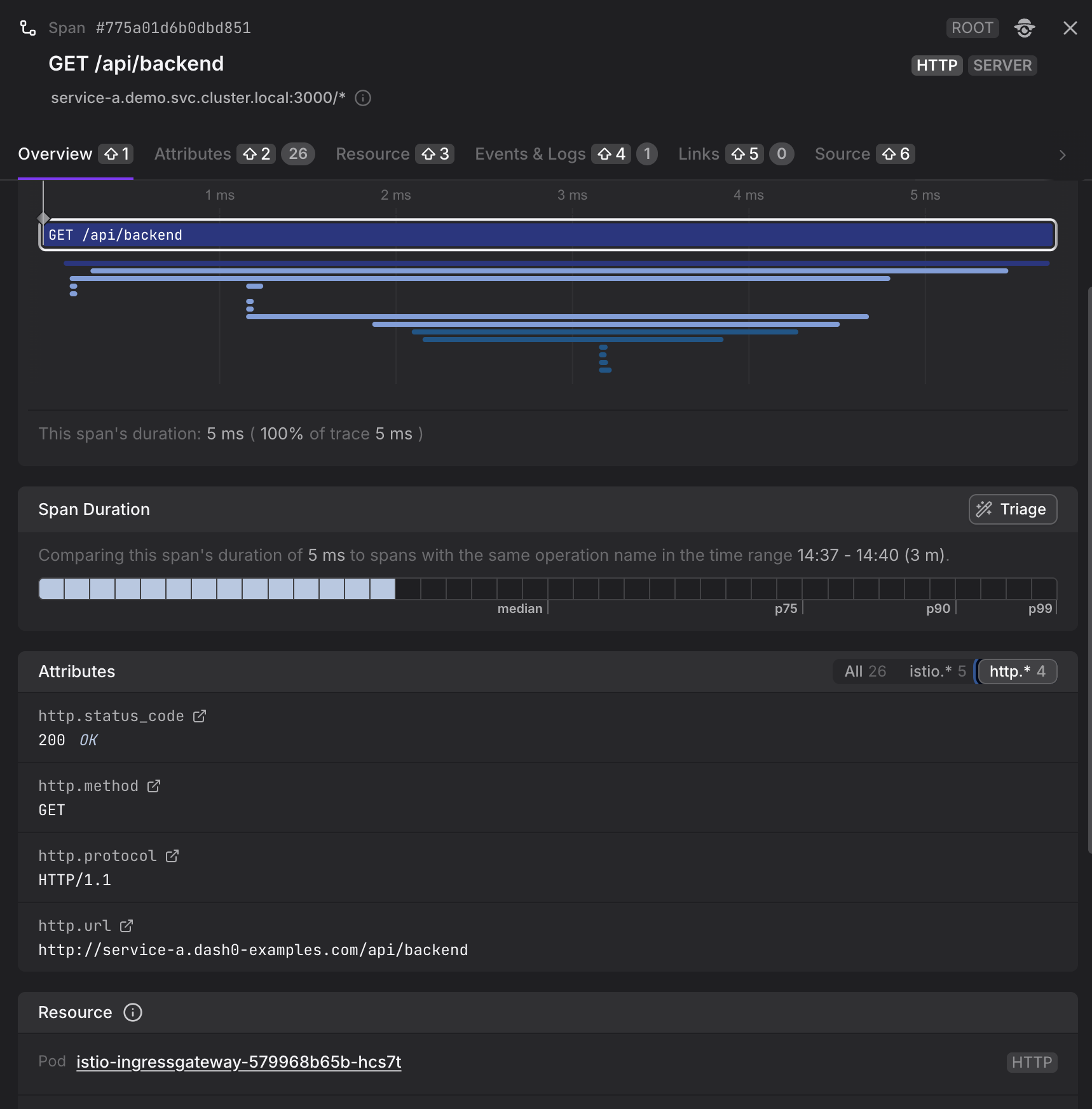
While traces are predictable and operationally useful, this reliance on deprecated semantics introduces forward-compatibility concerns as OpenTelemetry tooling increasingly expects stable conventions.
Access logs and trace correlation
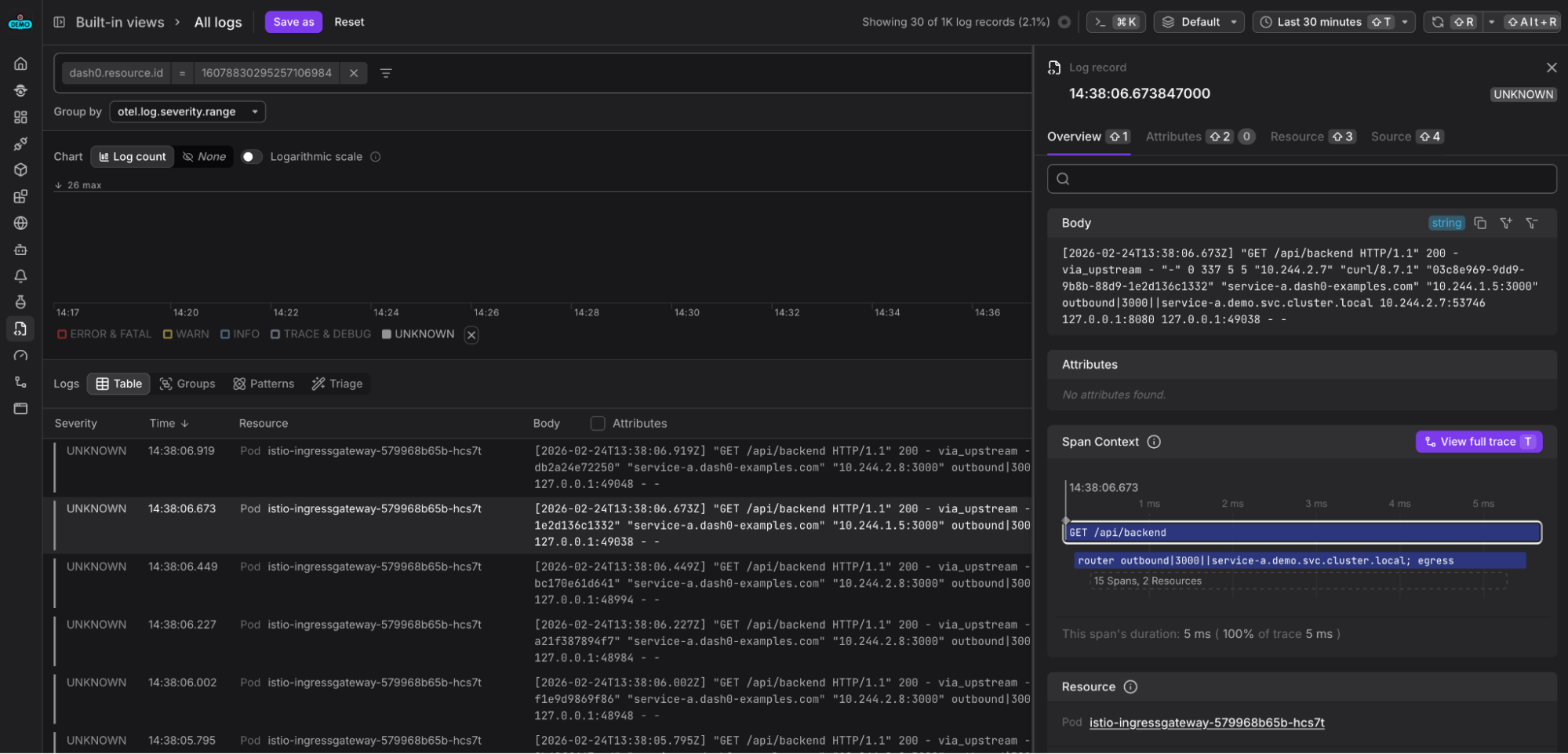
Istio Gateway emits access logs via OTLP through Envoy’s OpenTelemetry access log integration (envoyOtelAls). These logs capture ingress-level details such as HTTP method and path, response status, timing, routing decisions, and upstream metadata, and are delivered directly into an OpenTelemetry pipeline without relying on file-based log collection.
Trace correlation works out of the box. Istio populates the OTLP LogRecord traceId and spanId fields automatically, which allows observability backends to associate access logs with the corresponding gateway spans immediately. In practice, this makes it straightforward to move from an ingress span to the related access log entries without additional correlation logic.
The primary limitation lies in log structure rather than correlation. In the evaluated setup, the default configuration emits the access log payload as a single text string in the log body rather than structured OpenTelemetry log attributes. As a result, logs are correlated but not easily filterable or aggregatable by common fields such as status code, method, route name, or upstream cluster.
This is where the OpenTelemetry Collector plays a key role. It parses the log body, extracts structured attributes, and enriches records with Kubernetes metadata, turning correlated but unstructured logs into data that can be queried and analyzed effectively. Correlation is native at the source, while usability depends on downstream structuring and enrichment.
Metrics: Prometheus-native by design
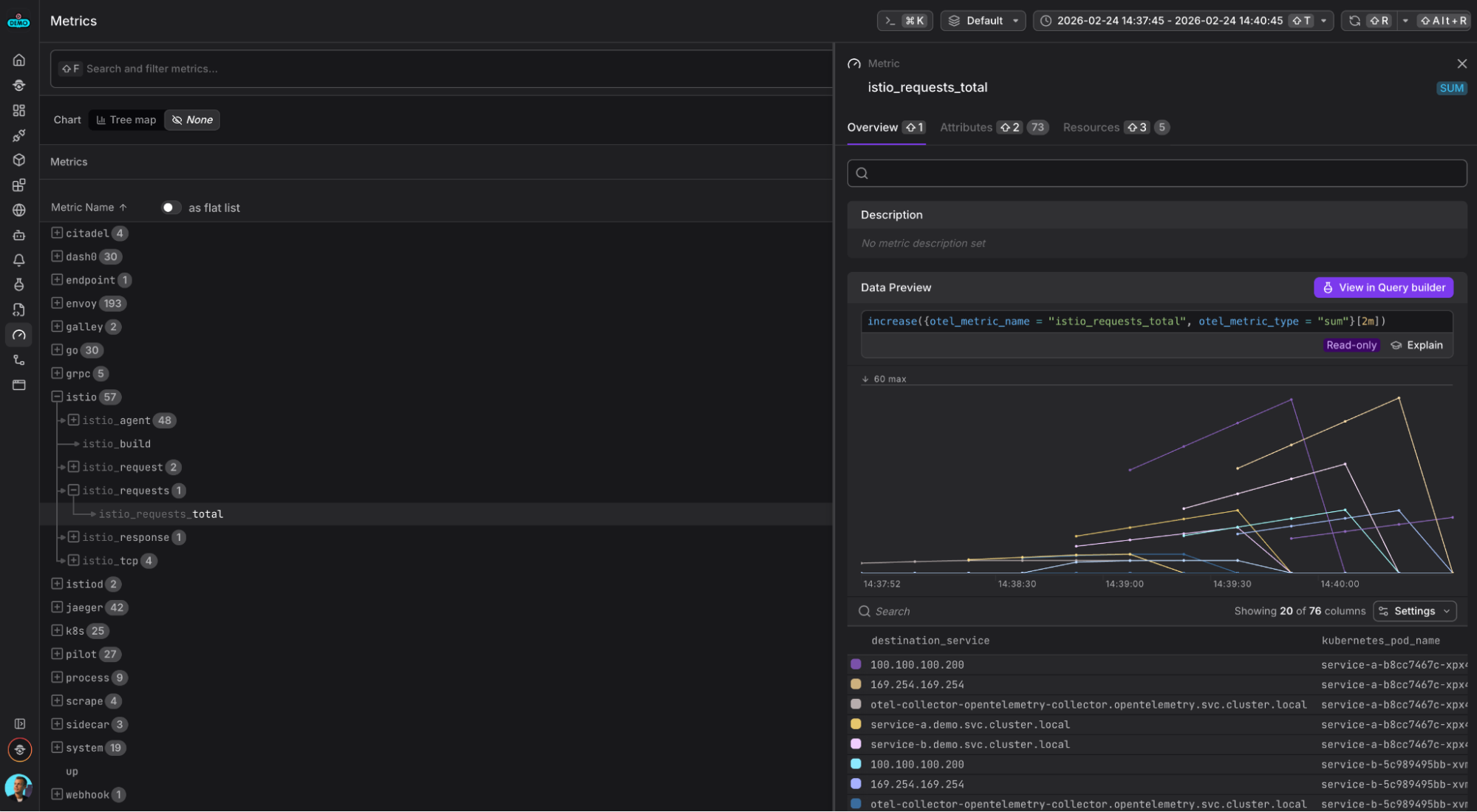
Metrics in Istio Gateway follow a deliberately Prometheus-native design rooted in Envoy and Istio’s long operational history. Envoy exposes a rich set of metrics covering request counts, response codes, latency histograms, upstream health, and connection-level behavior. Istio adds gateway-specific and control-plane metrics that reflect configuration and routing state.
In this evaluation, metrics are collected by the OpenTelemetry Collector using the Prometheus receiver. From there, they are enriched with Kubernetes metadata and queried using PromQL in Prometheus.
There is no OTLP export path for metrics at the source. As a result, metrics are emitted using Prometheus naming, units, and conventions rather than the OpenTelemetry metrics data model, which affects semantic alignment and cross-signal consistency. While the metrics themselves are comprehensive and operationally useful, the Prometheus-native approach constrains interoperability with OpenTelemetry-native backends and prevents Istio Gateway from participating fully in an OTLP-first, multi-signal observability model.
Summary view: Istio Gateway OpenTelemetry maturity
Before diving into each dimension in detail, it is useful to step back and consider how Istio Gateway’s OpenTelemetry support looks across the maturity model as a whole.
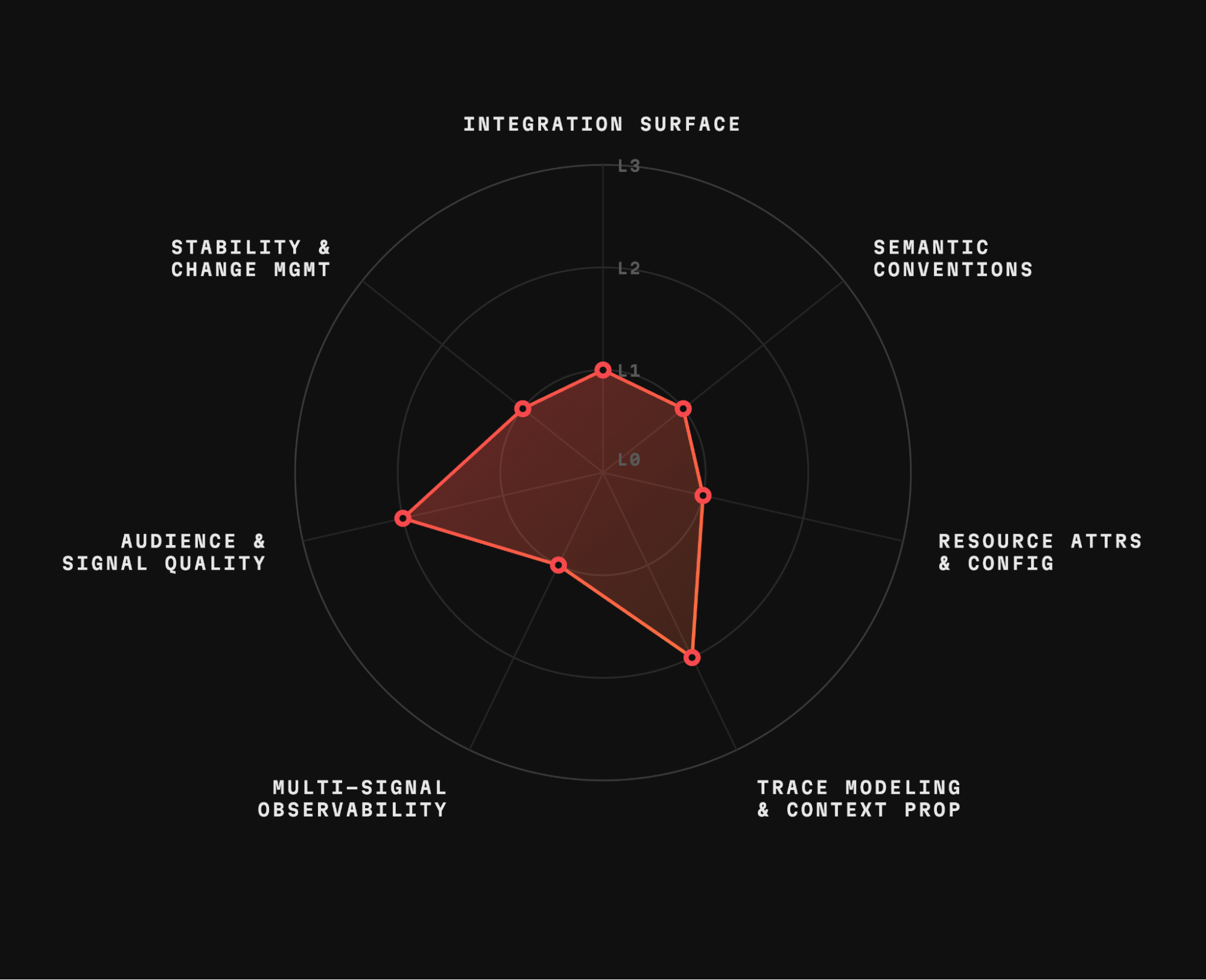
Each dimension is described along a progression across four qualitative levels of OpenTelemetry maturity, where higher values indicate deeper and more intentional OpenTelemetry integration. Rather than producing a single score, the goal is to show where the experience is already strong and where you are more likely to encounter friction when operating Istio Gateway as a shared ingress layer.
In Istio Gateway’s case, the overall shape reflects reliable tracing with deprecated semantics, comprehensive metrics that remain Prometheus-native, and access logs that are correlated by default but require downstream processing to become fully usable.
Dimension-by-dimension analysis
Integration surface
Istio Gateway presents a clear but layered integration surface. Tracing integrates cleanly with OpenTelemetry using OTLP, while logs and metrics follow separate ingestion paths and rely on the OpenTelemetry Collector to normalize and align them.
This model works well for teams already operating centralized Collectors, but it requires more configuration than projects that treat OTLP as the default interface across all signals.
Semantic conventions
A notable gap in Istio Gateway’s current OpenTelemetry implementation is the continued use of deprecated HTTP semantic conventions. Attributes such as http.method, http.status_code, and http.url originate from older specifications and have been superseded by stable alternatives.
Because these deprecated attributes are still emitted - and sometimes with incorrect types - you may need to implement normalization logic in their pipelines as backends and tooling increasingly expect stable semantic conventions.
Resource attributes & configuration
Resource identity in Istio Gateway is partially explicit and partially derived. Some service-level attributes are present, but Kubernetes resource attributes are typically added by the OpenTelemetry Collector using standard processors.
Configuration precedence between Istio settings and standard OpenTelemetry environment variables is not always obvious, which can make behavior harder to predict across environments without careful pipeline design.
Trace modeling & context propagation
Trace modeling in Istio Gateway is deliberate and focused. Traces represent synchronous request flows clearly, with consistent parent–child relationships and predictable span boundaries.
Context propagation follows open standards and behaves reliably across gateway and downstream services. While advanced trace features such as exemplars are not enabled by default, Envoy’s extensibility leaves room for such capabilities to be introduced.
Multi-signal observability
Istio Gateway emits all three signals - traces, metrics, and logs - but they are not designed as a unified system at the source. Tracing is OpenTelemetry-native, while logs and metrics require Collector-side alignment.
As a result, meaningful multi-signal observability is achieved through pipeline-level configuration rather than through an OTLP-first design across all signals.
Audience & signal quality
Istio Gateway’s telemetry is well suited for platform and infrastructure teams operating shared gateways. Traces and metrics provide deep insight into ingress behavior, routing decisions, and performance characteristics.
At the same time, effective use of the telemetry benefits from familiarity with Envoy, Istio, and the OpenTelemetry Collector. Defaults are powerful, widely used in production, and operationally proven, but their full behavior and trade-offs are easier to understand with that operational context.
Stability & change management
Istio is a mature project with a predictable release cadence. Observed telemetry behavior is stable in practice, which is essential for dashboards and alerts.
However, Istio does not populate the schema_url field in OTLP exports. The absence of schema tracking makes it difficult to determine which version of OpenTelemetry semantic conventions is implemented at the source and which can complicate migration planning as OpenTelemetry conventions evolve. As a result, telemetry behavior is stable, but the contract exposed does not currently align with the latest OpenTelemetry semantic conventions.
Where Istio Gateway lands
Taken together, Istio Gateway’s OpenTelemetry support reflects a mature project with strong operational capabilities, but one that is not yet fully aligned with current OpenTelemetry standards across all dimensions.
Tracing provides reliable context propagation and predictable span modeling, though it relies on deprecated semantic conventions that will require migration as the OpenTelemetry ecosystem evolves. Metrics are comprehensive and production-proven, but remain Prometheus-native, following established Envoy patterns rather than an OTLP-first design.
Logs demonstrate effective trace correlation out of the box, but the unstructured body format requires OpenTelemetry Collector processing to achieve full queryability and consistency. This positions the Collector as a central - and unavoidable - component for achieving coherent, multi-signal observability.
Overall, Istio Gateway sits firmly in an OTel-aligned position: OpenTelemetry is deeply integrated and operationally proven, while some aspects remain rooted in earlier conventions and Prometheus-native models.
Final thoughts
Istio Gateway demonstrates how far OpenTelemetry integration has progressed in large, complex infrastructure projects. Tracing is robust, metrics are rich and operationally valuable, and logs can be aligned effectively through standard pipelines.
At the same time, this analysis surfaces a recurring theme across the series: meaningful observability is shaped by signal availability, semantic correctness, schema tracking, and the ability to evolve safely over time.
For teams evaluating ingress options in a post–ingress-nginx world, Istio Gateway offers strong observability capabilities - particularly in service mesh-centric environments. Understanding where OpenTelemetry is native and where pipeline-level work is required helps set realistic expectations and points to clear opportunities for future refinement.