Emissary Ingress is an Envoy-based ingress controller with a long history in the Kubernetes ecosystem. Originally developed as Ambassador, the project has evolved through multiple architectural iterations while continuing to focus on flexibility, extensibility, and deep control over ingress behavior.
As OpenTelemetry has emerged as the standard for cloud-native observability, infrastructure components such as ingress controllers are increasingly expected to integrate cleanly into OpenTelemetry-based pipelines. For shared ingress layers in particular, observability means doing so in a way that is semantically correct, interoperable, and stable over time.
Ingress controllers sit at a critical boundary in Kubernetes architectures. They are the first hop for incoming traffic, they enforce routing and policy decisions, and they often represent the earliest point at which latency, errors, and availability can be observed. This makes them a natural focal point for evaluating how OpenTelemetry behaves in practice at the edge of the platform.
Recent developments in the Kubernetes ecosystem further underline the relevance of this evaluation. With the announcement that ingress-nginx is being retired from the Kubernetes project, many teams are reassessing their ingress choices and exploring alternatives. In that context, understanding how ingress controllers integrate with OpenTelemetry becomes an important input when making long-term platform decisions.
This post looks at how Emissary Ingress integrates with OpenTelemetry in practice, using a proposed OpenTelemetry support maturity model to describe how telemetry is produced, where it is OpenTelemetry-native, and where it depends on downstream processing. This framework is a proposal under active discussion in the OpenTelemetry community and is intended to surface integration characteristics rather than produce a definitive score. Rather than treating OpenTelemetry support as a binary feature, the goal is to understand how Emissary’s telemetry behaves in practice: where it is OpenTelemetry-native, where standard pipeline enrichment is expected, and how well the resulting signals support real operational workflows.
How we evaluate OpenTelemetry support
OpenTelemetry support rarely evolves uniformly across all signals. Tracing, logging, and metrics are often shaped by different historical decisions, upstream dependencies, and user expectations - particularly in infrastructure projects built on Envoy.
To make these differences easier to reason about, I’ll use a proposed maturity model that describes OpenTelemetry support across a set of dimensions - not as a scorecard, but as a way to describe where alignment happens and where it depends on the pipeline:
- Integration Surface – how users connect the project to observability pipelines
- Semantic Conventions – how consistently telemetry meaning aligns with OpenTelemetry conventions
- Resource Attributes & Configuration – how identity and configuration behave across environments
- Trace Modeling & Context Propagation – how traces are structured and how context flows
- Multi-Signal Observability – how traces, metrics, and logs work together in practice
- Audience & Signal Quality – who the telemetry is designed for and how usable it is by default
- Stability & Change Management – how telemetry evolves once users depend on it
Each dimension is described independently across four qualitative levels of OpenTelemetry maturity. Projects often land at different maturity levels across different dimensions, and that is expected. The purpose of the model is not to rank projects, but to make trade-offs visible and easier to discuss - especially as OpenTelemetry adoption deepens across the ecosystem.
The maturity model itself is still evolving and is being discussed openly in the OpenTelemetry community. This post should be read as an exploration of how Emissary’s OpenTelemetry integration behaves in practice, using the maturity model as a way to describe integration patterns - not as a definitive or final judgment.
Evaluation environment
The evaluation environment is intentionally simple and designed to reflect a common local development workflow.
Emissary Ingress v4.0.0-rc.1 is deployed in a local kind Kubernetes cluster and configured as the ingress controller. An OpenTelemetry Collector is deployed in-cluster and acts as the central alignment point for traces, logs, and metrics.
Request traffic is generated from outside the cluster to exercise ingress behavior directly. A small backend service runs inside the cluster to verify that trace context created or propagated by Emissary is preserved as requests flow downstream. This makes it possible to observe both ingress-level behavior and downstream trace continuity without introducing unnecessary complexity.
Telemetry is routed through the OpenTelemetry Collector and forwarded to Dash0 as the observability backend used in this evaluation. The same setup can alternatively route signals to an open source stack comprised of Jaeger (traces), Prometheus (metrics), and OpenSearch (logs). This mirrors a common OpenTelemetry deployment pattern, where the Collector normalizes and routes signals to different backends depending on signal type. The observations below focus on emitted telemetry structure and integration behavior rather than backend-specific capabilities.
The purpose of this environment is not to simulate production load, but to observe how Emissary’s telemetry behaves once enabled and how signals align when processed through an OpenTelemetry pipeline.
Tracing at the ingress
Tracing is the primary OpenTelemetry integration point for Emissary Ingress. Emissary supports exporting traces via OpenTelemetry by configuring a TracingService custom resource and selecting OpenTelemetry as the tracing driver.
Trace context propagation follows the W3C Trace Context specification. Incoming traceparent headers are preserved, and when no upstream context is present, Emissary creates a new trace at the ingress boundary. Requests entering the cluster are traceable from the point they arrive at the platform, and context is propagated correctly to downstream services.
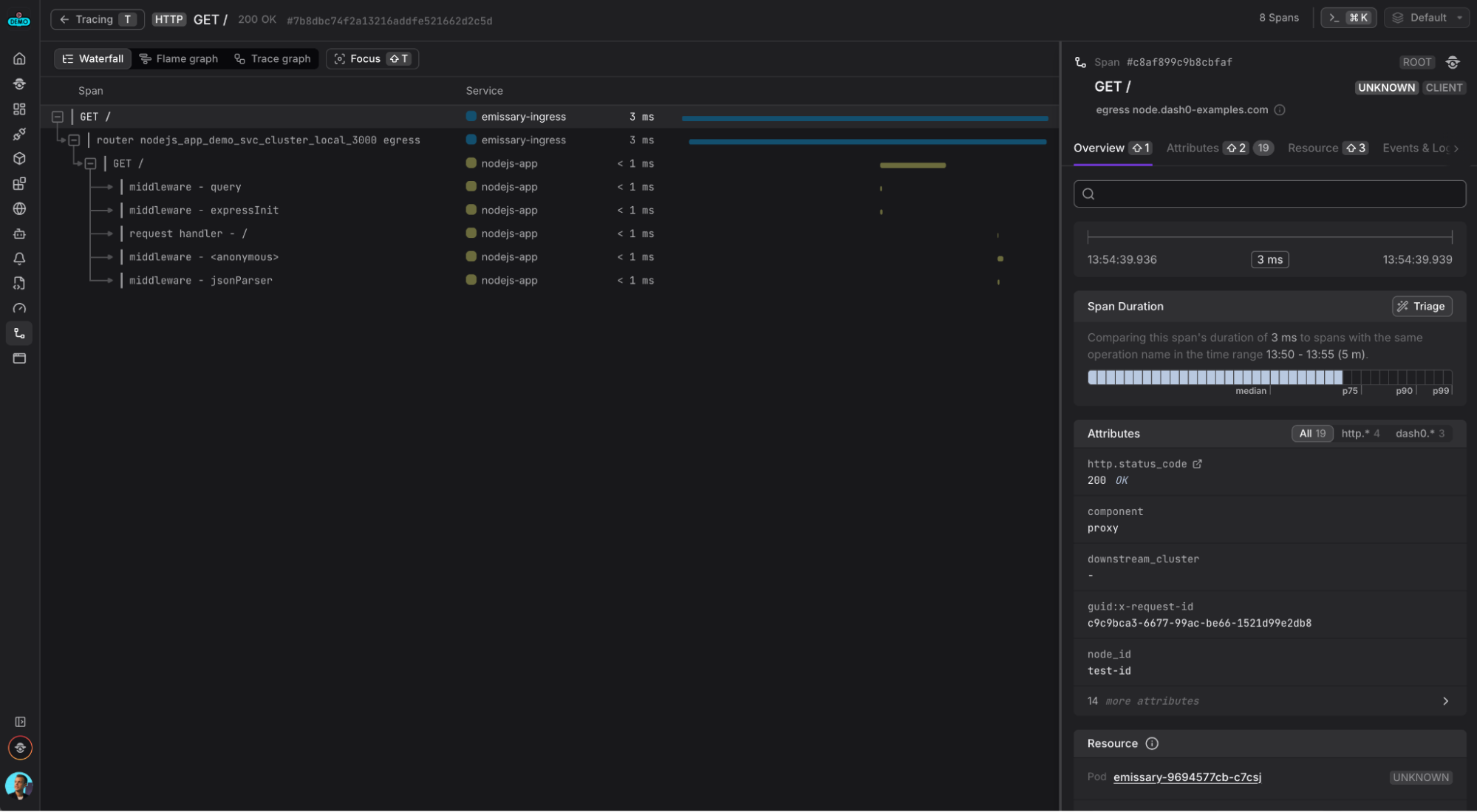
However, while trace context propagation works reliably, trace modeling itself contains a fundamental semantic issue. In the evaluated version, ingress entry spans are emitted with a CLIENT span kind rather than SERVER.
In OpenTelemetry, SERVER spans represent inbound request handling and are expected to appear at the start of a request lifecycle. CLIENT spans represent outbound calls and are expected to have a parent span.Using CLIENT spans as root spans for inbound ingress traffic conflicts with OpenTelemetry span semantics and misrepresents the role of the ingress in the trace.
As a result, traces appear structurally complete - spans exist, parent-child relationships are present, and downstream propagation works - but they are semantically incorrect. Server-side latency, ingress responsibility, and request handling behavior cannot be interpreted correctly using standard OpenTelemetry assumptions.
This issue has practical consequences. Automated analysis, latency attribution, and cross-service comparisons become unreliable, and you must mentally compensate for incorrect span roles when interpreting traces.
Access logs and trace correlation
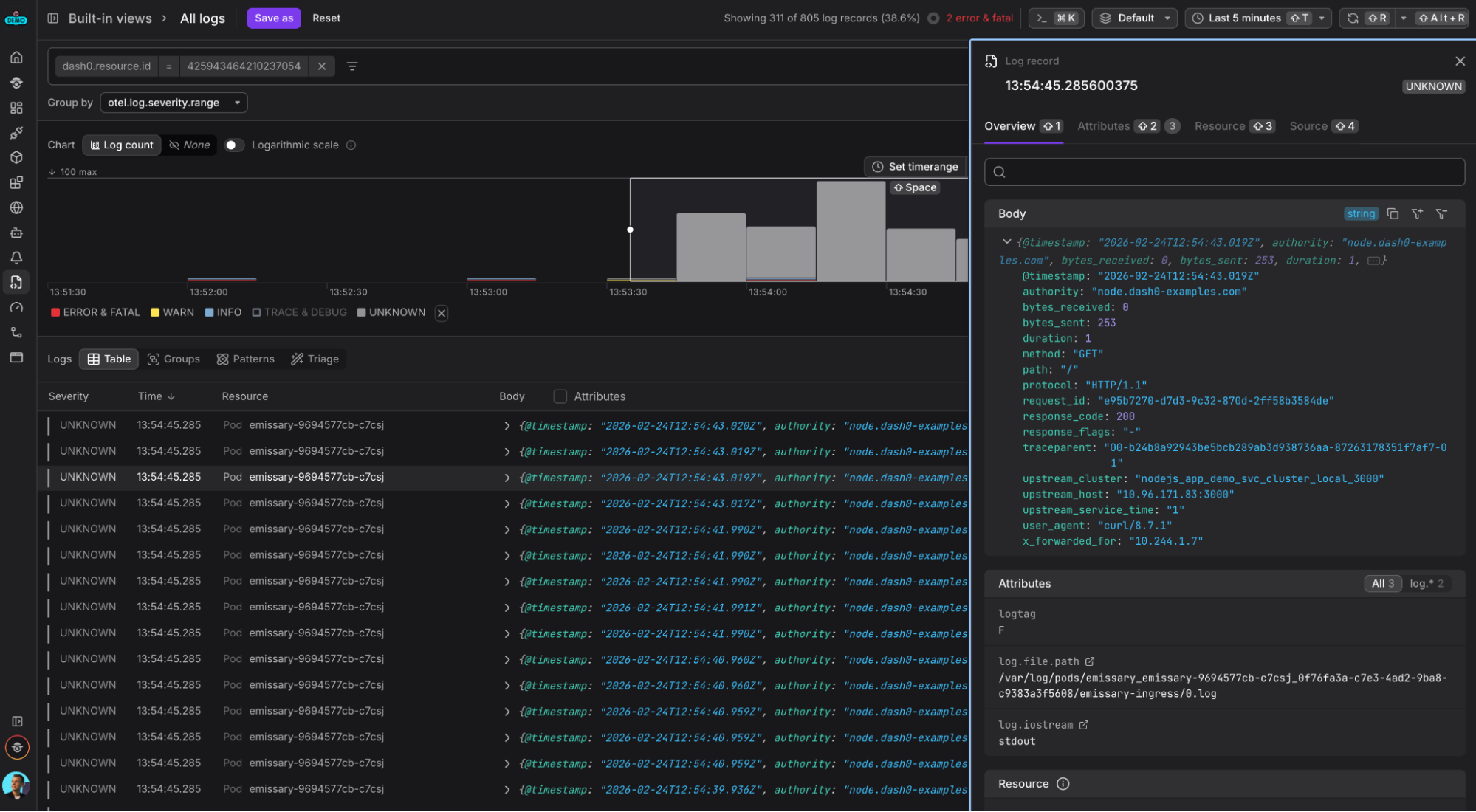
Emissary emits structured access logs as JSON to stdout. These logs include HTTP request and response details such as method, path, status code, timing, routing decisions, and upstream information. They are designed to be consumed by log aggregation systems rather than read directly from files.
Trace context is not embedded in access logs by default. Correlation between traces and logs therefore depends on OpenTelemetry Collector–side processing. In the evaluation setup, the Collector ingests container logs, applies custom parsing logic, extracts trace and span identifiers where possible, and enriches the resulting log records.
This makes the OpenTelemetry Collector a critical component in the observability pipeline. Without Collector-side processing, logs and traces remain parallel but disconnected signals. With it, operators can move from a trace to the corresponding ingress logs to understand routing decisions, response codes, or upstream behavior.
This design places responsibility for correlation firmly in the pipeline rather than at the source. While this is workable, it increases operational complexity and makes cross-signal correlation dependent on correct Collector configuration.
Metrics: Prometheus-native by design
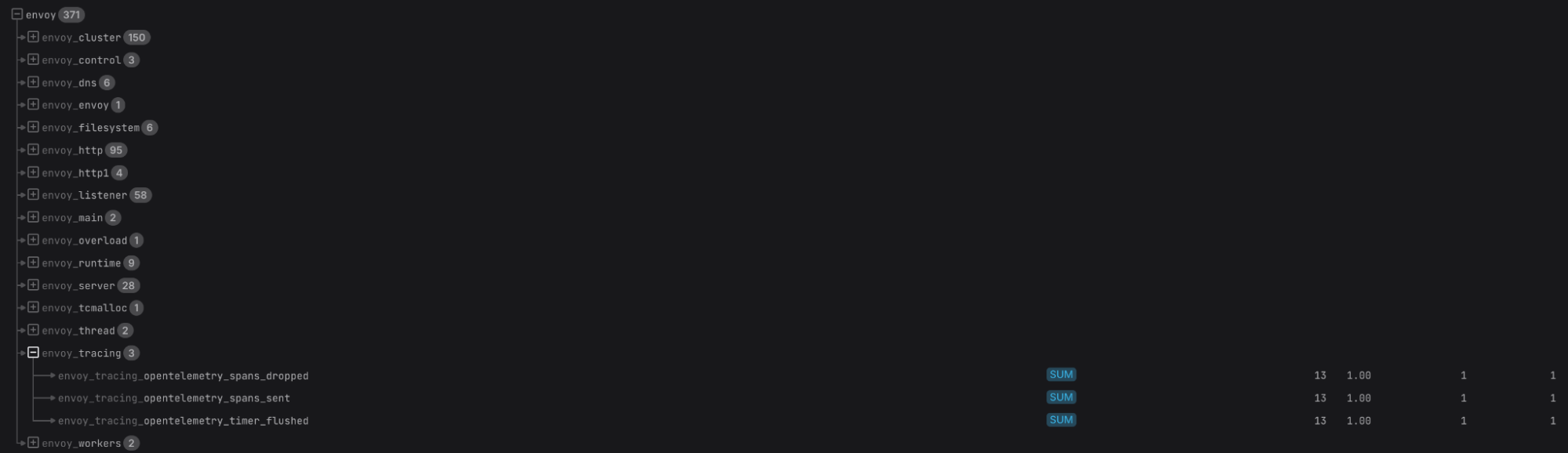
Metrics in Emissary follow a traditional Envoy model. Emissary and Envoy expose metrics in Prometheus format, covering request counts, response codes, latency histograms, upstream health, and controller-level behavior.
Metrics are collected by the OpenTelemetry Collector using the Prometheus receiver. From there, they can be enriched with Kubernetes metadata, and sent to an observability backend.
One additional source of friction is naming. While the project is now Emissary Ingress, many controller-level metrics continue to use the legacy ambassador_* prefix rather than an emissary_* namespace. This reflects Emissary’s historical evolution, but it can be confusing for operators.
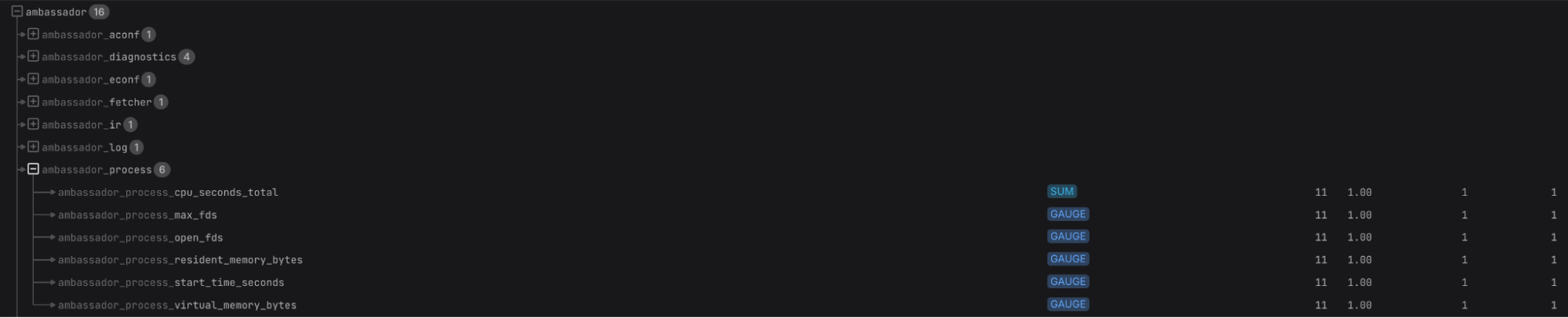
There is no OTLP export path for metrics at the source. As a result, metrics remain Prometheus-native and are collected, labeled, and queried differently from traces and logs. While this does not prevent effective monitoring, it reinforces that Emissary does not yet offer a unified, OTLP-first multi-signal model.
Summary view: Emissary OpenTelemetry maturity
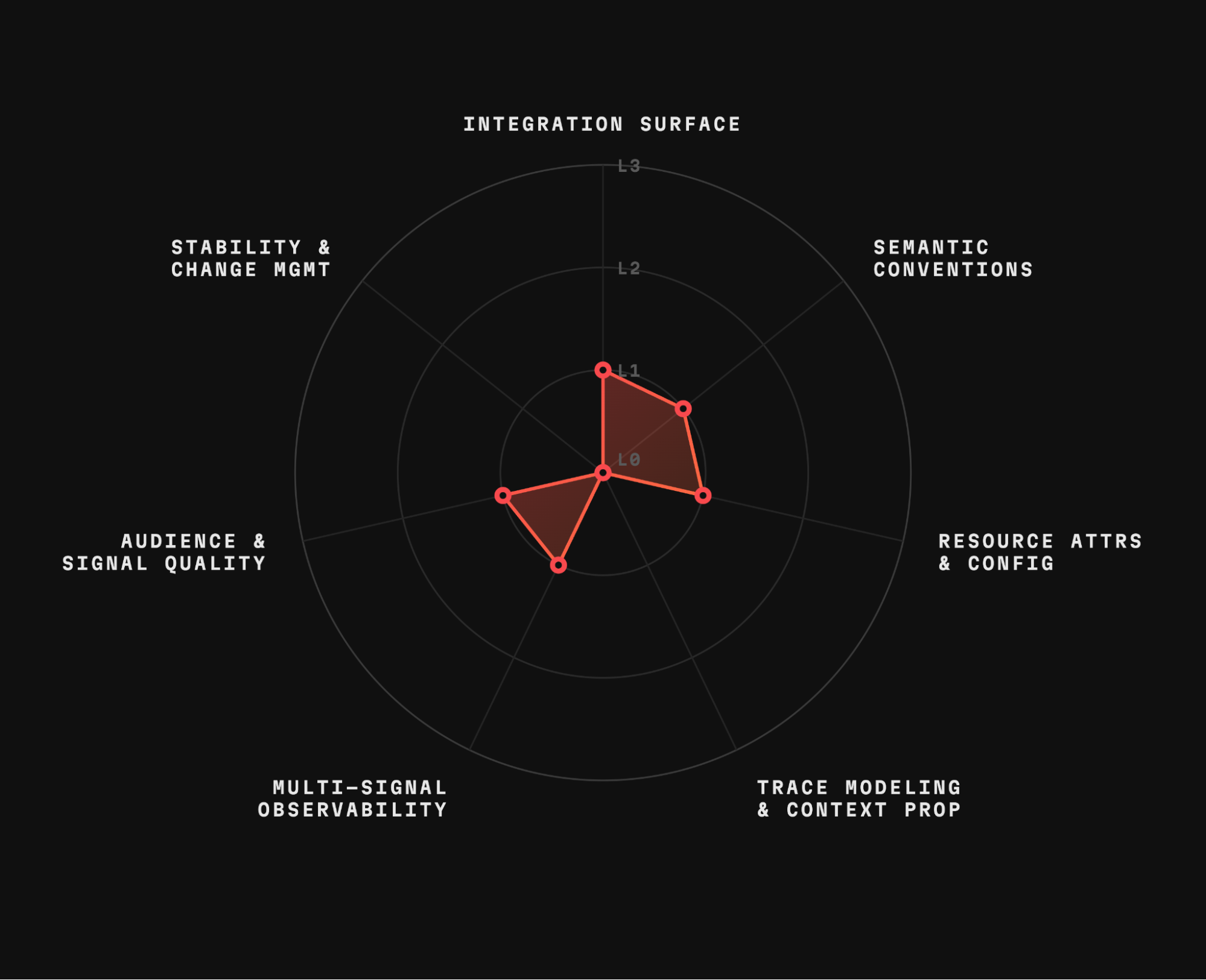
Before diving into each dimension in detail, it’s useful to step back and look at how Emissary’s OpenTelemetry support shapes up across the maturity model as a whole.
Each dimension is described along a progression across four qualitative levels of OpenTelemetry maturity, where higher values indicate deeper and more intentional OpenTelemetry integration. The goal of this view is not to produce a single score, but to show where the experience is already usable and where you are likely to encounter friction.
In Emissary’s case, the overall shape reflects a project where OpenTelemetry support exists, but where correctness, consistency, and stability limit how safely that support can be relied on in practice.
Dimension-by-dimension analysis
The sections that follow walk through each dimension in turn, grounding this high-level view in concrete observations from the evaluation environment.
Integration surface
From an integration perspective, Emissary presents a mixed model.
Tracing integrates with OpenTelemetry via OTLP and Kubernetes-native configuration, but requires explicit custom resource definitions and restarts to take effect. Logs and metrics follow separate ingestion paths and rely heavily on the OpenTelemetry Collector to normalize and align them.
In practice, this makes the Collector the primary integration surface. OpenTelemetry integration works, but the integration surface extends beyond the ingress itself and into pipeline configuration.
Semantic conventions
Emissary’s telemetry largely reflects Envoy’s existing conventions. HTTP attributes are present and useful, but rely on older OpenTelemetry semantic conventions rather than the current stable recommendations.
This limits interoperability with generic dashboards, queries, and tools that expect up-to-date OpenTelemetry semantics. While experienced users can interpret the signals correctly, the reliance on deprecated conventions increases long-term migration cost.
Resource attributes & configuration
Emissary exposes a stable service identity, but resource modeling at the source is minimal.
Standard service-level attributes such as service.namespace, service.version, and service.instance.id are not consistently set. Kubernetes resource attributes such as pod, workload, node, and cluster identifiers are largely absent at the source and must be added via Collector-side enrichment.
Runtime customization of resource identity is limited, and supported detectors are not documented as part of an explicit observability contract. In practice, stable identity is achieved through downstream enrichment rather than source-level modeling.
Trace modeling & context propagation
While context propagation follows open standards and behaves reliably, incorrect span semantics undermine trace correctness.
Using CLIENT spans for inbound ingress traffic breaks OpenTelemetry expectations and affects both human and automated trace analysis. This is a fundamental issue that limits OpenTelemetry maturity regardless of signal availability.
Multi-signal observability
Emissary emits traces, logs, and metrics, but they are not designed as a unified system at the source.
Correlation between traces and logs depends on Collector-side parsing and enrichment, and metrics remain Prometheus-native. Meaningful multi-signal observability is possible, but it is achieved through pipeline-level alignment rather than an OTLP-first design.
Audience & signal quality
Emissary’s telemetry is primarily oriented toward maintainers and advanced operators.
Signals are expressive but require significant domain knowledge to interpret correctly. Experimental warnings, lack of semantic guarantees, and reliance on pipeline customization limit how broadly usable the telemetry is by default.
Stability & change management
Emissary is a mature project, but its OpenTelemetry integration is explicitly marked as work-in-progress and not recommended for production use.
There is limited documentation around semantic stability, no telemetry-specific change communication, and long-standing issues affecting trace correctness remain unresolved. You rely on implicit behavior rather than explicit guarantees.
Many of these characteristics reflect historical design decisions and broader ecosystem patterns rather than Emissary-specific shortcomings.
Final thoughts
Emissary Ingress exposes a wide range of telemetry signals, but its current OpenTelemetry implementation has fundamental limitations that affect correctness, interoperability, and stability.
This analysis shows where Emissary works well today, where it introduces friction, and what would be required to align it more closely with modern OpenTelemetry expectations. As ingress controllers become increasingly strategic infrastructure components, semantic accuracy and signal consistency matter as much as signal availability.
The maturity model used here is intended to make these design choices visible and easier to discuss as OpenTelemetry becomes foundational infrastructure.
This should be read as an exploration of how Emissary’s OpenTelemetry integration behaves in practice, and as a contribution to a broader discussion about how we describe OpenTelemetry support across the ecosystem.