Contour is a CNCF-graduated ingress controller built on Envoy and widely used in Kubernetes environments. As OpenTelemetry adoption has matured across the cloud-native ecosystem, ingress controllers are increasingly expected to integrate cleanly into OpenTelemetry-based observability pipelines with predictable behavior across traces, logs, and metrics.
Ingress controllers sit at a critical boundary in Kubernetes architectures. They are the first hop for incoming traffic, they enforce routing and policy decisions, and they often represent the earliest observable point for understanding user-perceived latency and failure modes. This makes them a natural focus for evaluating how well OpenTelemetry works in practice at the infrastructure edge.
Recent developments in the Kubernetes ecosystem further underline the importance of understanding ingress controller behavior and telemetry maturity. With the announcement that ingress-nginx is being retired from the Kubernetes project, many users are reassessing their ingress choices and evaluating alternatives such as Contour, Gateway API–based implementations, and other Envoy-powered data planes. In that context, observability - and specifically how ingress controllers integrate with OpenTelemetry - becomes an important input when making long-term platform decisions.
This post looks at Contour’s OpenTelemetry integration in practice, using a set of dimensions to describe how telemetry is produced, where it integrates natively, and where it depends on downstream processing. Rather than treating OpenTelemetry support as a binary feature, the goal is to examine how Contour’s telemetry behaves in practice: where it integrates natively, where it relies on downstream processing, and how well the resulting signals support real operational workflows.
The approach used here is still evolving and being discussed within the OpenTelemetry community. It should be understood as a way to describe integration characteristics and trade-offs, not as a definitive or standardized scoring model. The purpose of this evaluation is to surface trade-offs and friction points in a structured way, not to deliver a final verdict.
How we evaluate OpenTelemetry support
OpenTelemetry support rarely evolves uniformly across all signals. Tracing, logging, and metrics are often shaped by different historical decisions, upstream dependencies, and user expectations, particularly in infrastructure projects built on Envoy.
To make these differences easier to reason about, I’ll use a structured set of dimensions that reflect how OpenTelemetry is applied in practice - not as a scorecard, but as a way to describe where alignment happens and where it depends on the pipeline.
- Integration Surface – how users connect the project to observability pipelines
- Semantic Conventions – how consistently telemetry meaning aligns with OpenTelemetry conventions
- Resource Attributes & Configuration – how identity and configuration behave across environments
- Trace Modeling & Context Propagation – how traces are structured and how context flows
- Multi-Signal Observability – how traces, metrics, and logs work together in practice
- Audience & Signal Quality – who the telemetry is designed for and how usable it is by default
- Stability & Change Management – how telemetry evolves once users depend on it
Each dimension is described independently. Projects often land at different maturity levels across different dimensions, and that is expected. The value of the maturity model lies in making trade-offs visible and discussable rather than collapsing everything into a single score.
The model itself is still evolving and is being discussed openly in the OpenTelemetry community. This post should be read as an application of the framework, not as a definitive or final judgment of Contour’s observability design.
Evaluation environment
The evaluation environment is intentionally simple and designed to reflect a common local development workflow. Contour runs in a local kind cluster and is configured using the Gateway API. An OpenTelemetry Collector receives telemetry from Envoy and acts as the central alignment point for traces, logs, and metrics.
Request traffic is generated from the local machine to exercise ingress behavior. A small backend service runs inside the cluster to verify that trace context created or propagated by Contour is preserved as requests flow downstream. This makes it possible to observe both ingress-level behavior and downstream trace continuity without introducing unnecessary complexity.
For visualization and cross-signal analysis, telemetry is routed through an OpenTelemetry Collector into Dash0. This makes it possible to observe traces, logs, and metrics in a unified view, while still preserving the original signal characteristics emitted by Contour and Envoy. This setup mirrors a common OpenTelemetry deployment pattern, where the Collector normalizes and routes signals to different backends depending on signal type.
The choice of backend does not affect the observations below, which focus on emitted telemetry structure and integration behavior rather than visualization features.
The purpose of this setup is not to simulate production load, but to evaluate how Contour’s telemetry behaves once enabled and how signals align when processed through a modern OpenTelemetry pipeline.
Tracing at the ingress
Tracing is the strongest aspect of Contour’s OpenTelemetry integration. Envoy spans are exported via OTLP using Envoy’s ExtensionService, making OpenTelemetry the primary export path for tracing rather than a secondary or optional integration.
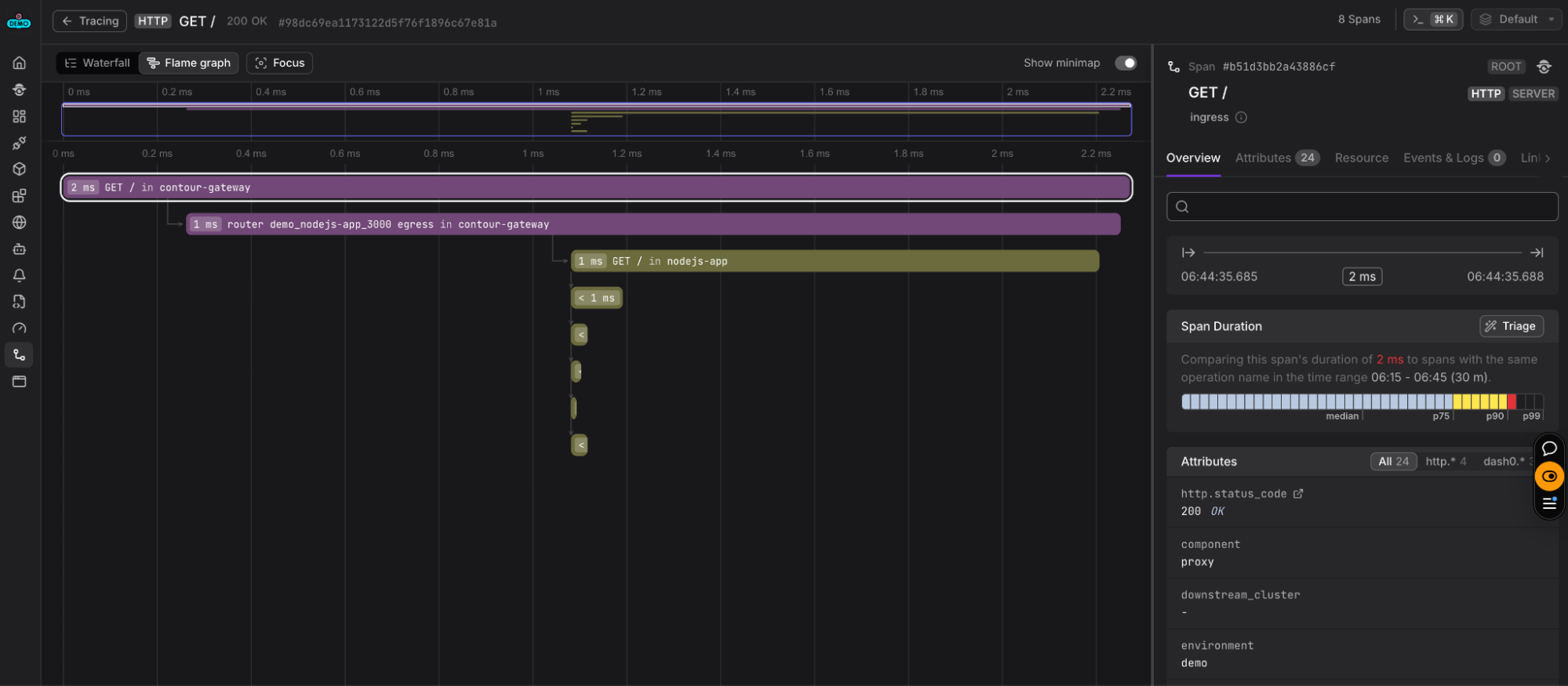
Trace context propagation follows the W3C Trace Context specification. When an incoming traceparent header is present, Contour participates correctly in the existing trace by creating a new span and propagating updated context downstream. When no upstream context exists, Contour starts a new trace at the ingress boundary. Every request entering the cluster gets a well-defined trace root, and downstream services receive consistent trace context aligned with the spans generated at the gateway.
Span structure reflects Envoy’s execution model and focuses on synchronous request handling. Parent–child relationships between ingress spans and backend spans are preserved, making it straightforward to reason about how requests flow through the gateway and into downstream services.
While customization of span naming and hierarchy is limited, the resulting traces are predictable and consistent. If you are familiar with Envoy-based proxies, you can interpret Contour traces without needing project-specific knowledge, which is an important property for shared infrastructure components.
Access logs and trace correlation
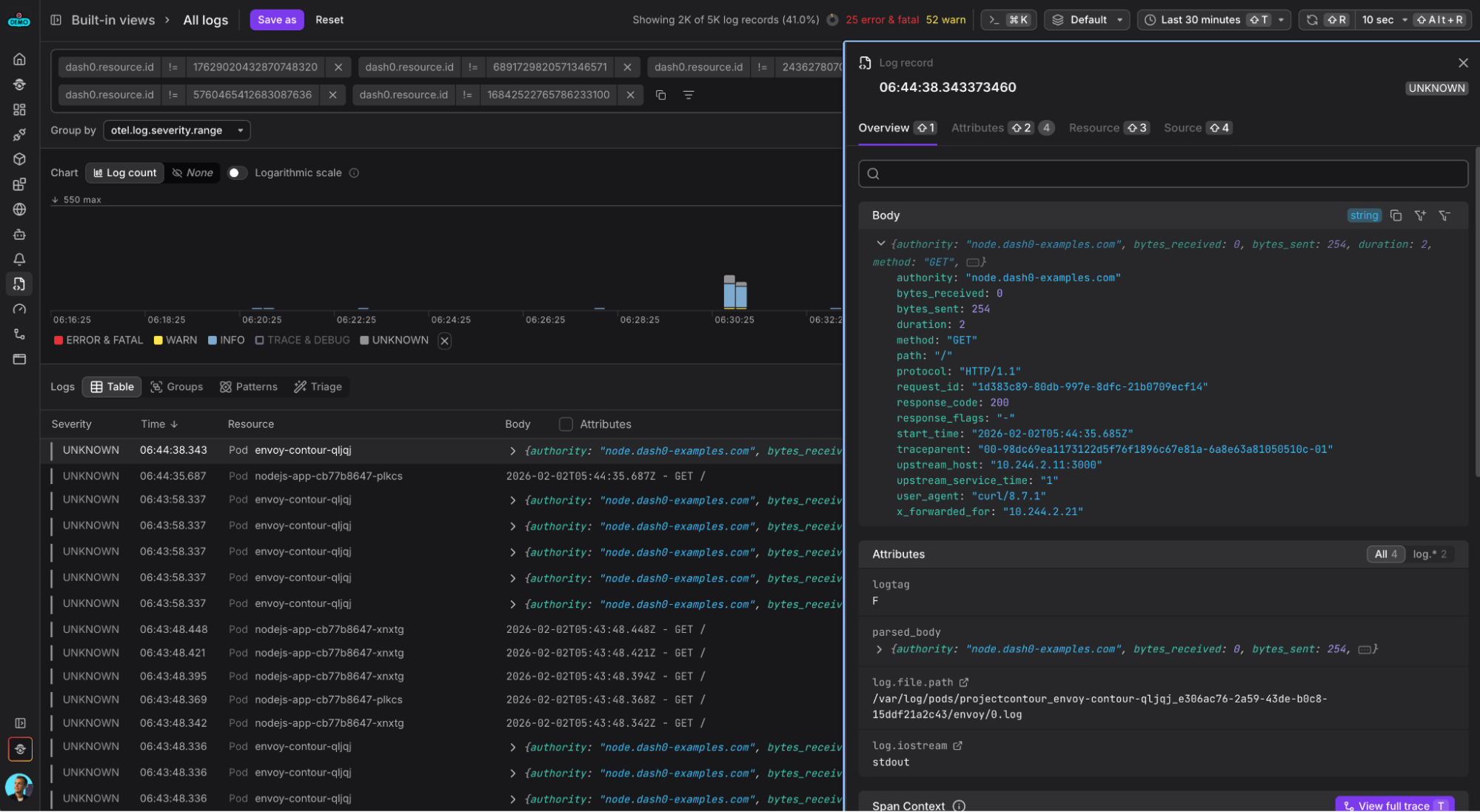
Contour emits structured access logs as JSON to stdout. These logs include HTTP request and response details such as method, path, status code, timing, and upstream information, and they are designed to be consumed by log aggregation systems rather than read directly from files.
Trace context is embedded in the access logs, enabling correlation with tracing data. However, this correlation is not automatic at the source. Instead, it depends on the OpenTelemetry Collector to ingest the logs, apply a custom parsing pattern, extract trace and span identifiers, and enrich the resulting log records.
This makes the Collector a critical component in the observability pipeline. Without Collector-side processing, logs and traces would remain parallel but disconnected signals. With it, operators can move naturally from a trace to the corresponding ingress logs to understand routing decisions, response codes, or upstream behavior.
This approach works well in practice, but it also shows where responsibility lies. Signal alignment is achieved at the pipeline level rather than being fully modeled by Contour itself.
Metrics: Prometheus-native by design
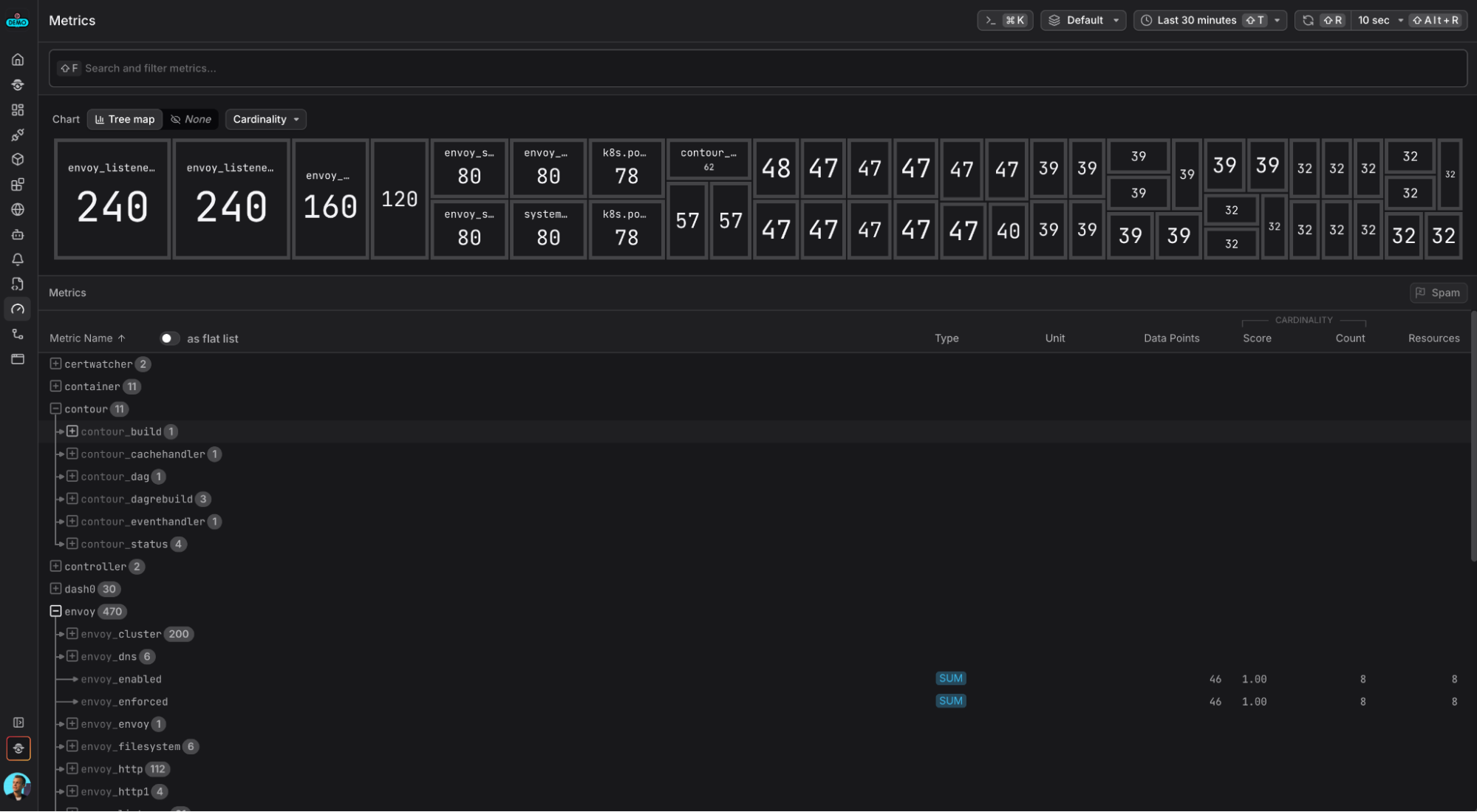
Metrics follow a traditional model. Contour and Envoy expose metrics exclusively in Prometheus format, covering request counts, response codes, latency histograms, upstream health, and controller-level behavior.
Metrics are scraped by the OpenTelemetry Collector using the Prometheus receiver. From there, they can be enriched with Kubernetes metadata and made available to downstream analysis tools.
There is no OTLP export path for metrics today. As a result, metrics remain Prometheus-native and are collected via scraping, then translated or forwarded downstream. They are modeled differently from traces and logs at the source, even if later aligned in the pipeline. This split does not prevent effective observability, but it does mean that Contour currently combines OpenTelemetry-native tracing with a Prometheus-first metrics model rather than a unified, OTLP-first multi-signal design.
Summary view: Contour OpenTelemetry maturity
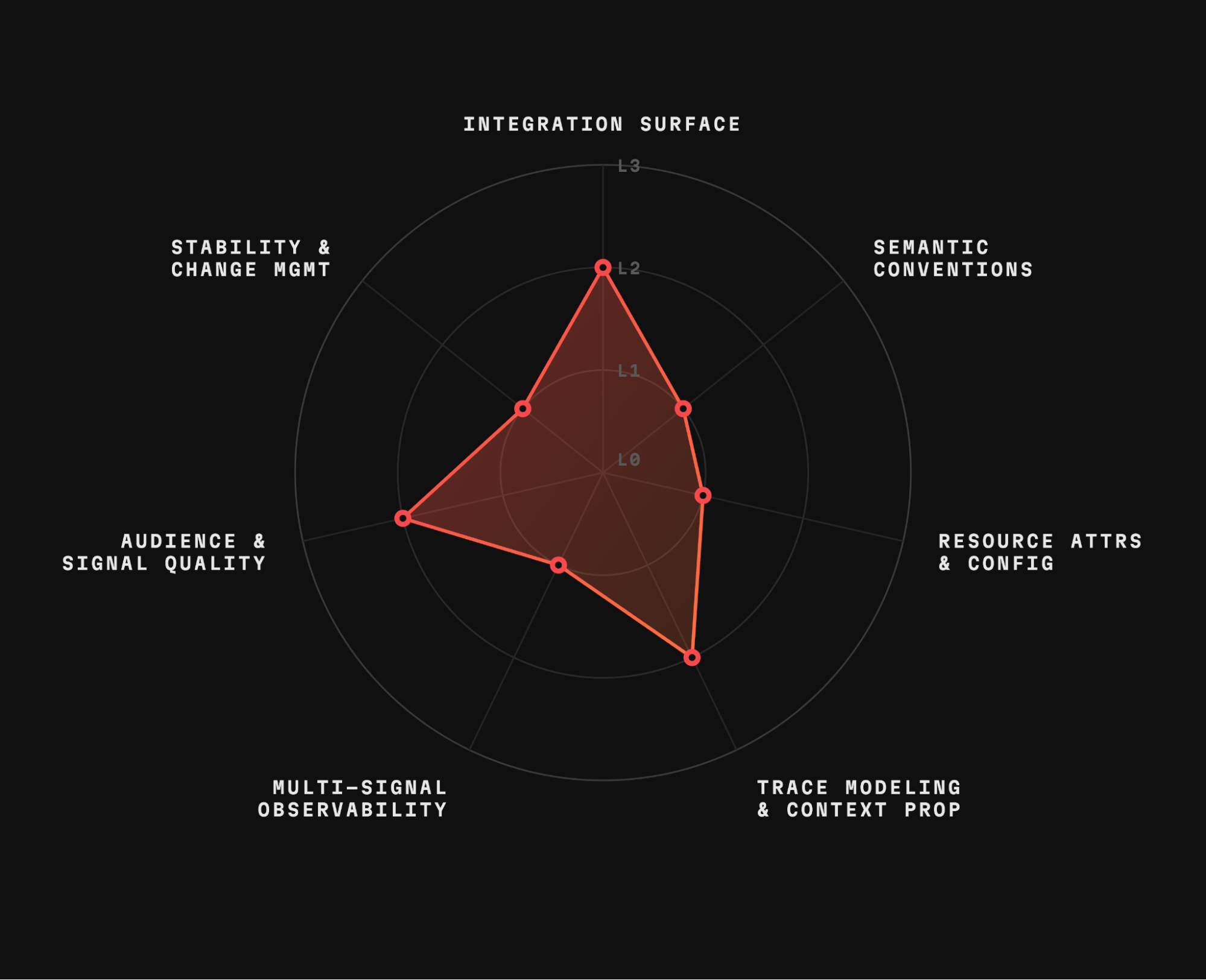
Before diving into each dimension in detail, it’s useful to step back and consider how Contour’s OpenTelemetry support shapes up across the framework as a whole.
Each dimension is described along a progression from 0–3, where higher values indicate deeper and more intentional OpenTelemetry integration. These levels are descriptive rather than prescriptive. They are intended to surface observable integration characteristics, not to assign value judgments to architectural trade-offs. The purpose of this evaluation isn’t to produce a single aggregate score, but to show where the experience is already strong and where you are more likely to encounter friction when operating Contour as a shared ingress layer.
In Contour’s case, the overall shape reflects a project with strong, OpenTelemetry-native tracing, high-quality access logs that can be correlated with traces once processed through an OpenTelemetry Collector, and a more traditional, Prometheus-first approach to metrics. Resource identity and semantic alignment are largely achieved through downstream enrichment rather than explicit modeling at the source.
Dimension-by-dimension analysis
The sections that follow walk through each dimension in turn, grounding this high-level view in concrete observations from the evaluation environment.
Integration surface
From an integration perspective, Contour presents a mixed model.
Tracing integrates cleanly with OpenTelemetry using OTLP as the primary export path from Envoy. Logs and metrics, however, are not emitted over OTLP. Instead, they follow separate ingestion paths and rely on the OpenTelemetry Collector to scrape, parse, and normalize them before alignment with traces. See the Multi-signal observability section for a more in-depth analysis.
In practice, this makes the Collector the central integration surface. It is responsible for parsing access logs, extracting trace context, scraping metrics, and enriching all signals with shared context. OpenTelemetry integration works well, but the integration surface extends beyond the ingress itself and into pipeline configuration.
This makes the OpenTelemetry Collector the practical integration boundary for Contour’s observability story, rather than the ingress controller itself.
Semantic conventions
Contour’s telemetry largely reflects Envoy’s existing conventions. HTTP attributes are present and useful, but many rely on deprecated OpenTelemetry semantic conventions rather than the latest stable recommendations, such as http.status_code instead of the newer http.response.status_code convention.
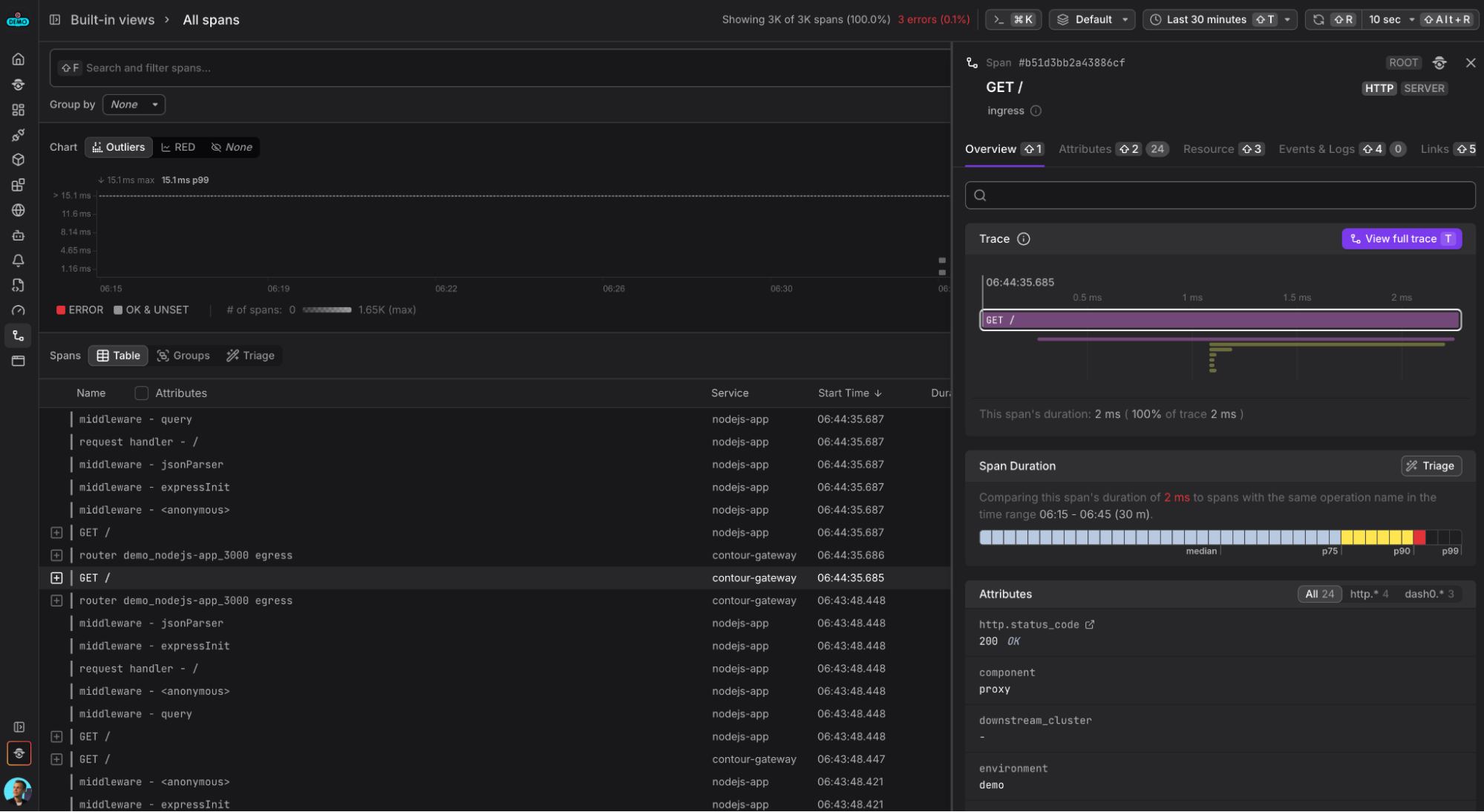
This is a common characteristic of Envoy-based projects and reflects upstream constraints rather than project-specific design decisions. Telemetry meaning is generally clear to experienced users, but full alignment with current semantic conventions would improve interoperability with generic dashboards, queries, and tooling.
This is also visible in the trace view from the evaluation, where deprecated HTTP attributes are still present.
Resource attributes & configuration
Contour exposes a stable service.name for tracing and behaves predictably across namespaces and environments. The default value can be overridden through Contour’s tracing configuration, allowing operators to control how ingress spans are identified in downstream observability systems.
Beyond this, however, resource identity at the source remains minimal. Standard service-level attributes such as service.namespace and service.version are not set. While OpenTelemetry guidance suggests aligning service.instance.id with k8s.pod.uid, this relationship is not explicitly modeled or documented at the source. As a result, naming and identity are not fully consistent across signals without downstream normalization.
Kubernetes resource attributes such as k8s.pod.uid, workload identifiers, node attributes, and cluster identifiers are largely absent from emitted telemetry. Instead, OpenTelemetry Collector processors are expected to infer and enrich this context based on deployment topology and pipeline configuration. This makes enrichment behavior sensitive to Collector placement and configuration rather than being intrinsic to the telemetry itself.
Runtime customization of resource identity is also limited. Standard OpenTelemetry mechanisms such as OTEL_RESOURCE_ATTRIBUTES are not consistently honored, and supported resource detectors are not described as part of an explicit observability contract.
In practice, stable and expressive resource identity is achieved through downstream enrichment rather than source-level modeling. While this approach is workable, it shifts additional responsibility onto adopters. Within the context of the proposed maturity framework, this reflects a model where resource identity is achieved primarily through downstream enrichment rather than being explicitly modeled at the source.
Trace modeling & context propagation
Trace modeling in Contour is deliberate and focused on the ingress layer’s core responsibility: handling synchronous HTTP request flows. Traces clearly represent the lifecycle of a request as it enters the cluster, with predictable span boundaries and stable parent–child relationships that reflect Envoy’s execution model.
Context propagation follows open standards and behaves reliably across ingress and downstream services. Incoming trace context is preserved when present, and new traces are started correctly at the ingress boundary when no upstream context exists. This means requests are always observable from the point they enter the system, which is particularly important for shared gateways that sit in front of many independent workloads.
More advanced propagation scenarios or domain-specific trace semantics - such as alternative context formats or custom span hierarchies - are not addressed by default. However, this is largely a function of Envoy’s default behavior rather than a hard limitation. Envoy’s extensibility model leaves room for such capabilities to be introduced where needed, either through configuration or custom extensions.
Overall, the resulting trace model prioritizes clarity, correctness, and predictability over expressiveness. For a shared ingress layer, this is an appropriate trade-off.
Multi-signal observability
Contour emits traces, logs, and metrics, but they are not modeled as a unified OpenTelemetry-native system at the source.
Correlation between traces and logs is achieved through Collector-side processing, particularly through custom log parsing and enrichment. Metrics remain Prometheus-native and are aligned with other signals primarily through timestamps and shared resource enrichment rather than direct linkage.
This places the OpenTelemetry Collector at the center of multi-signal observability. Meaningful cross-signal workflows are absolutely achievable, but they emerge through pipeline design rather than being inherently encoded in the emitted telemetry.
Audience & signal quality
Contour’s telemetry is well suited for platform and infrastructure teams operating shared ingress controllers.
The signals focus on gateway-level concerns such as routing behavior, response codes, latency, and upstream interactions. Access logs are structured, readable, and emphasize operationally relevant details. Traces provide clear insight into ingress behavior and downstream propagation.
Defaults support common debugging workflows without extensive customization, while avoiding application-specific semantics. This clearly defines the intended audience and keeps the signal surface stable for long-term operational use.
Stability & change management
Contour is a mature project with a predictable release cadence. Observed telemetry behavior is stable and consistent, which is essential for dashboards, alerts, and long-lived operational workflows.
At the same time, telemetry does not appear to be treated as an explicit compatibility contract. There is limited documentation around semantic stability, no schema versioning, and no telemetry-specific change communication. You therefore rely on implicit stability rather than explicit guarantees when upgrading or evolving observability pipelines.
Where Contour fits in the proposed framework
Taken together, Contour’s OpenTelemetry support reflects a pragmatic and functional level of maturity.
Tracing is OpenTelemetry-native and reliable. Access logs are high quality and can be correlated with traces once processed through an OpenTelemetry Collector. Metrics remain Prometheus-first, and resource identity depends heavily on downstream enrichment.
This shape is common among Envoy-based ingress controllers today. It shows both how far OpenTelemetry integration has come and where further evolution - particularly around resource modeling, semantic alignment, and unified multi-signal design - could reduce operational friction over time.
Final thoughts
Contour demonstrates that effective OpenTelemetry support does not require full adoption across every signal to deliver real value. Strong trace propagation, high-quality access logs, and a clean tracing integration surface already support meaningful operational workflows.
At the same time, this evaluation makes the role of the OpenTelemetry Collector explicit. For Contour, the Collector is the component that aligns signals, enables correlation, and turns emitted telemetry into something you can reason about.
Looking ahead, incremental improvements - such as more explicit resource identity, closer alignment with current semantic conventions, and gradual movement toward a more unified OTLP-first model - could further strengthen Contour’s OpenTelemetry story without compromising stability.
The maturity framework used here is intended to support that discussion and make progress visible over time. The same proposed framework will be applied to other ingress and Gateway API implementations to compare how OpenTelemetry integration patterns differ across projects.