A comparative view on maturity, patterns, and gaps
Ingress controllers sit at one of the most critical points in a Kubernetes architecture. Every inbound request passes through them, making ingress the natural starting point for distributed traces, access logs, and request-level metrics. If observability is missing or inconsistent at this layer, downstream telemetry becomes harder to interpret, correlate, and trust.
Ingress is also where many operational questions originate. Why is latency increasing? Which backend is actually handling traffic? Are retries happening? Are requests failing before they ever reach an application? Without clear telemetry at the ingress layer, these questions often lead to blind spots, partial answers, or expensive guesswork.
Over the past months, this series has examined OpenTelemetry support across several widely used ingress controllers and gateways. Rather than treating OpenTelemetry integration as a binary capability, each project was evaluated using a draft maturity framework that looks at how intentionally and consistently OpenTelemetry is applied across traces, logs, and metrics.
This post brings those individual evaluations together. Instead of repeating project-specific deep dives, it focuses on what the comparisons reveal about the current state of OpenTelemetry adoption in ingress controllers as a category - and what we learned by applying the maturity framework itself across multiple real-world implementations.
Projects included in the comparison
The comparison is based on hands-on evaluations of the following ingress controllers and gateways:
- Contour
- Emissary Ingress
- Istio Gateway
- kgateway
- Traefik
Each evaluation was performed in a Kubernetes environment using an OpenTelemetry Collector as the central alignment point for traces, logs, and metrics. Request traffic was generated externally, and downstream services were used only to validate trace propagation and correlation behavior.
The goal was not to benchmark performance or feature completeness, but to understand how each project models telemetry at the ingress layer, how much work is required to make signals usable together, and how closely emitted telemetry aligns with current OpenTelemetry expectations.
Traefik is not a CNCF project, but it is included due to its strong OpenTelemetry focus and its relevance in real-world ingress deployments.
What about ingress-nginx?
Ingress-nginx is intentionally not included in this maturity comparison.
While ingress-nginx was previously evaluated for OpenTelemetry support, the Kubernetes community has since announced the retirement of the project. Given that decision, it no longer made sense to apply a forward-looking maturity framework or invest in a full evaluation as part of this series.
For readers interested in ingress-nginx’s OpenTelemetry support as it existed prior to the deprecation announcement, a detailed analysis from September 2025 is available on the Dash0 blog.
The exclusion of ingress-nginx further underscores why observability maturity matters when teams are selecting a long-term ingress replacement. As organizations migrate, they are implicitly choosing not just an ingress controller, but an observability model that will shape how they debug, operate, and scale their platforms.
How OpenTelemetry support is evaluated
OpenTelemetry adoption rarely progresses evenly across all telemetry signals. Tracing, logging, and metrics often evolve independently, shaped by historical conventions, proxy capabilities, and ecosystem tooling.
To make these differences easier to reason about, this series applies a draft OpenTelemetry Support Maturity Framework that evaluates projects across seven independent dimensions:
- Integration Surface – how users connect the project to observability pipelines
- Semantic Conventions – how consistently telemetry aligns with OpenTelemetry semantics
- Resource Attributes & Configuration – how identity and configuration behave across environments
- Trace Modeling & Context Propagation – how traces are structured and how context flows
- Multi-Signal Observability – how traces, logs, and metrics work together in practice
- Audience & Signal Quality – who the telemetry is designed for and how usable it is by default
- Stability & Change Management – how telemetry evolves once users depend on it
Each dimension is evaluated independently on a 0–3 scale. The intent is not to rank projects or collapse everything into a single score, but to surface trade-offs and friction points that affect real-world operability.
This distinction turned out to be particularly important for ingress controllers, where some signals appear “good enough” in isolation, but reveal deeper issues when evaluated in combination.
Summary view: ingress controller OpenTelemetry maturity
Before diving into cross-cutting observations, the radar chart below provides a high-level overview of how the evaluated ingress controllers compare across the framework, including an aggregate average that reflects overall maturity trends.
Each axis represents one maturity dimension. Higher values indicate deeper, more intentional OpenTelemetry integration, but the purpose of this visualization is not comparison for its own sake. Instead, it highlights where the ecosystem is already strong and where users are most likely to encounter limitations.
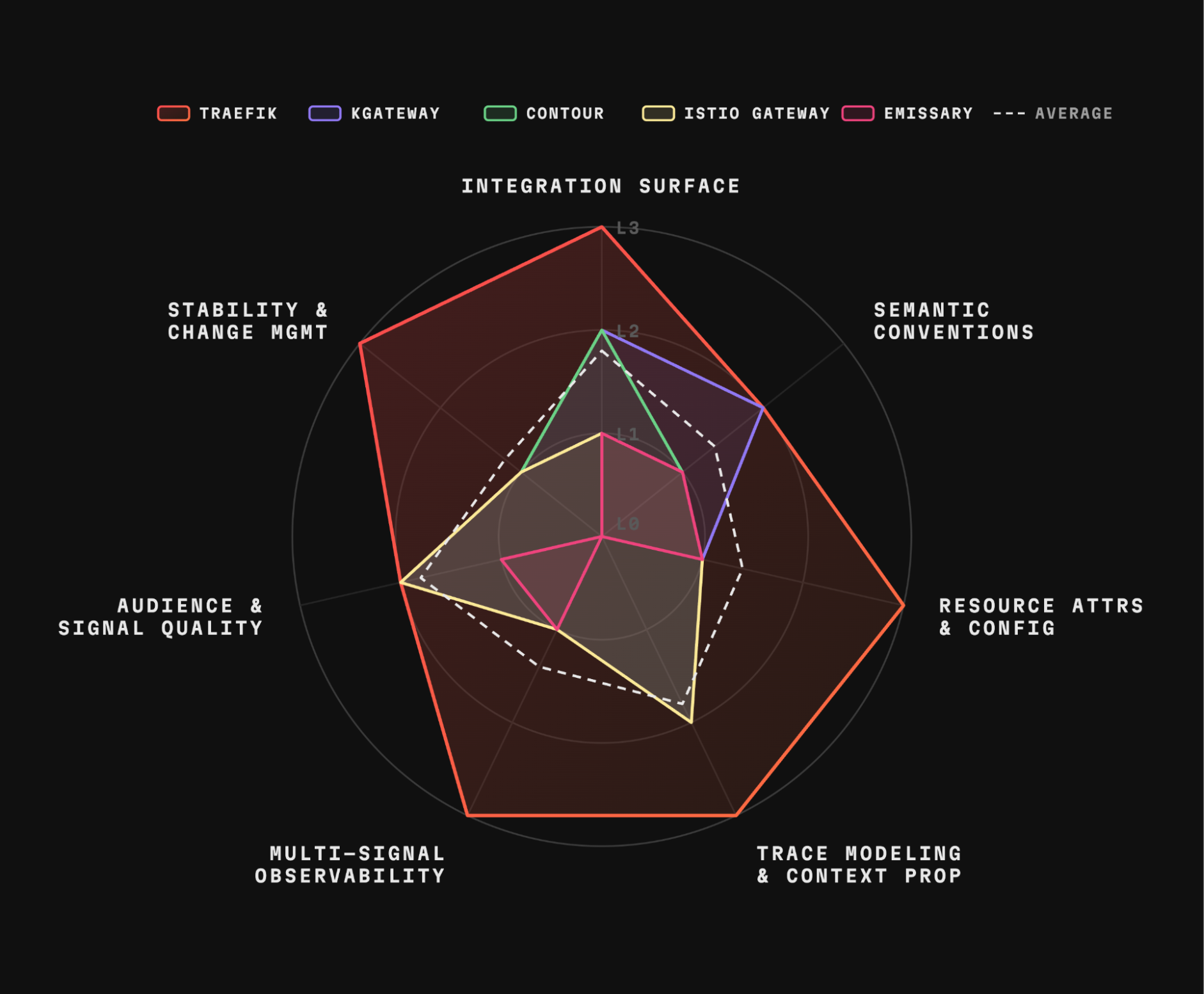
Even without reading the individual evaluations, a clear pattern emerges. Tracing tends to score higher across projects, while semantic conventions, metrics, and long-term stability cluster lower. This shared shape is one of the most valuable outcomes of the comparison.
What the comparison reveals about ingress controllers
Tracing is consistently strong
Across all evaluated ingress controllers, tracing is the most mature signal.
Common characteristics include predictable span boundaries at the ingress layer, reliable W3C Trace Context propagation, and consistent parent–child relationships between gateway spans and downstream services. This makes it possible to reason clearly about request flow, latency, retries, and routing decisions starting at the edge.
This consistency is largely due to a shared foundation: almost all evaluated ingress controllers are built on Envoy. Envoy provides robust tracing capabilities out of the box, and most projects have leaned into that strength early.
However, tracing maturity is not uniform in terms of standards compliance. Many ingress controllers still emit deprecated HTTP semantic conventions rather than the current stable attributes defined in newer OpenTelemetry specifications. Attributes such as http.method and http.status_code remain common, even though they have been superseded by http.request.method and http.response.status_code. In some cases, attribute types are also incorrect.
Operationally, tracing works well. Strategically, this semantic lag creates forward-compatibility risk as OpenTelemetry tooling increasingly assumes stable conventions.
Access logs are improving, but uneven
Access logging shows greater variation across projects.
Some ingress controllers emit logs via OTLP with trace and span identifiers embedded directly in the log records. Others emit logs in text or JSON formats that require parsing and enrichment downstream. In many cases, trace–log correlation is possible, but only after pipeline-level processing.
As a result, the OpenTelemetry Collector becomes a critical component in nearly all ingress observability setups. Even when correlation identifiers are present at the source, structuring logs and enriching them with Kubernetes metadata typically happens in the pipeline.
This is not inherently wrong, but it shifts responsibility from the ingress controller to the platform team. The more work required in the pipeline, the easier it is to introduce inconsistencies, blind spots, or operational fragility.
Traefik stands out here. Although its OTLP log export is currently marked experimental, it demonstrates a clear intent to treat OpenTelemetry as a first-class logging interface rather than an optional integration layered on top of traditional log formats.
Metrics remain predominantly Prometheus-native
Metrics are where the ecosystem diverges most clearly from OpenTelemetry’s long-term direction.
Across nearly all evaluated ingress controllers, metrics are exposed in Prometheus format and collected via scraping. Even when an OpenTelemetry Collector is involved, it often acts as a Prometheus scraper rather than an OTLP receiver.
This approach is familiar and operationally proven. However, it comes with important trade-offs. Prometheus-native metrics lack the semantic richness, explicit units, and well-defined aggregation semantics provided by the OpenTelemetry metrics model. This makes it harder to reason consistently about metrics across components and harder to align metrics with traces and logs.
In practice, this means users often see three different mental models: OpenTelemetry-style traces, partially structured logs, and Prometheus-style metrics. Each is useful, but the lack of a shared semantic foundation limits cross-signal analysis.
Traefik again represents an exception by exporting metrics via OTLP at the source. Even when those metrics are ultimately stored in Prometheus format, this preserves OpenTelemetry semantics at the producer and allows greater flexibility in downstream routing and analysis.
Multi-signal observability is usually achieved in the pipeline
A consistent theme across all evaluations is that multi-signal observability is rarely modeled at the source.
Instead, traces, logs, and metrics are emitted through different mechanisms and aligned later using shared resource attributes and Collector-side enrichment. This approach works, but it places significant responsibility on platform teams to design and maintain correct observability pipelines.
Ingress controllers that treat OpenTelemetry as a primary integration surface reduce this operational burden by making signal alignment more predictable out of the box.
Envoy as both enabler and constraint
Envoy underpins nearly every ingress controller evaluated. This has a dual effect.
On the positive side, Envoy provides high-quality tracing and a rich set of metrics, giving projects a strong baseline. On the limiting side, Envoy’s defaults - including deprecated semantic conventions and Prometheus-centric metrics - are inherited unless projects actively diverge from them.
As a result, many ingress controllers share not only common strengths, but also common gaps. Improving OpenTelemetry support at the ingress layer may therefore require not just project-level changes, but upstream alignment around Envoy defaults and migration paths.
A brief note on Cilium
As part of this comparison, we also looked at Cilium Ingress to understand its current level of OpenTelemetry support.
Cilium occupies a slightly different space than the other ingress controllers evaluated, combining networking, security, and observability concerns. While it exposes a rich set of Prometheus metrics and provides detailed flow visibility through Hubble, direct OpenTelemetry support for ingress-related telemetry is currently limited.
The previously available hubble-otel integration has been deprecated, and OpenTelemetry is no longer a first-class export path. In practice, OpenTelemetry users rely on the OpenTelemetry Collector to scrape Cilium’s Prometheus metrics and integrate them into broader observability pipelines.
This makes it possible to observe Cilium Ingress using OpenTelemetry tooling at the pipeline level, but unlike the other ingress controllers in this series, OpenTelemetry is not treated as a native or intentional integration surface within the project itself.
What this comparison tells us about the maturity framework itself
While this series has focused on evaluating ingress controllers, it has also served as a practical test of the maturity framework itself. Applying the same dimensions consistently across multiple ingress implementations surfaced clear patterns - not just in project behavior, but in how well the framework captures meaningful differences in OpenTelemetry adoption.
Looking at the combined radar chart and aggregated scores, several observations stand out.
The framework consistently separates signal availability from signal quality. Nearly all evaluated ingress controllers emit traces, logs, and metrics in some form, but dimensions such as Semantic Conventions, Resource Attributes & Configuration, and Multi-Signal Observability reveal whether that telemetry is interoperable, consistent, and future-proof.
Tracing maturity clustered higher than other dimensions, reflecting Envoy’s strong foundation. At the same time, the framework correctly prevented projects from reaching the highest maturity level when semantic debt, missing schema tracking, or limited configurability were present.
Metrics emerged as the weakest and most uneven dimension, reinforcing that OpenTelemetry-native metrics adoption at the ingress layer is still early. The framework proved sensitive to this gap without penalizing projects simply for using Prometheus.
Semantic Conventions surfaced as an ecosystem-wide issue rather than a project-specific one. Deprecated attributes, incorrect types, and missing schema tracking appeared consistently across Envoy-based ingress controllers.
Stability & Change Management also emerged as a weak point. Telemetry behavior appeared stable in practice, but rarely treated as an explicit, versioned contract. Missing schema_url fields and lack of telemetry-specific change communication limited maturity here.
Overall, the framework held up well. A few refinements may be worth exploring - such as clearer guidance around upstream constraints inherited from Envoy and sharper distinction between OTLP transport and semantic richness - but no structural changes are required. The framework proved effective at comparing projects fairly and surfacing actionable differences.
Where this leaves the ecosystem
Taken together, these evaluations paint a consistent picture:
Tracing is broadly strong and reliable.Access logs are improving, but uneven.Metrics remain largely Prometheus-native.
Signals are largely disconnected, using neither consistent resource attributes nor trace-context correlation.Collectors are essential for correlation and enrichment.Semantic conventions lag behind current OpenTelemetry standards.
Ingress controllers are clearly on the OpenTelemetry path, but most remain somewhere between OTel-aligned and OTel-native. The maturity framework helps make these trade-offs explicit and provides a shared vocabulary for discussing roadmap priorities and integration gaps.
Final thoughts
Ingress controllers define the first mile of observability. As teams move away from ingress-nginx and reassess their ingress layer, OpenTelemetry support should be evaluated alongside performance, security, and operational complexity.
This is becoming increasingly important as OpenTelemetry adoption accelerates across the cloud-native ecosystem. According to the latest CNCF Annual Cloud Native Survey, 49% of respondents now use OpenTelemetry in production, and an additional 26% are actively evaluating it. Together, that means three out of four organizations are either already relying on OpenTelemetry or preparing to do so.
At this level of adoption, OpenTelemetry is no longer an experimental integration or a “nice to have.” Platform engineers and SREs increasingly expect first-class OpenTelemetry support from the infrastructure components they deploy, including ingress controllers. Telemetry that requires heavy customization, semantic translation, or fragile pipeline logic introduces friction precisely where teams are trying to standardize and simplify.
The evaluations in this series show meaningful progress. Tracing is broadly reliable, access logging is improving, and the OpenTelemetry Collector provides a powerful alignment layer. At the same time, they also reveal how much work remains. Metrics are still predominantly Prometheus-native, semantic conventions lag behind current specifications, cross-signal correlation is generally weak, and telemetry stability is rarely treated as an explicit, versioned contract.
The foundation is already there. The next step is refinement: updating semantic conventions, embracing OTLP where it makes sense, and treating telemetry as a long-lived interface rather than an implementation detail.
The radar chart tells a story - but the real value lies in what projects choose to do next.