Introducing Darkplane, by Dash0: the control room for the AI that writes your code.
AI now writes a growing share of the code we ship, and it reaches production faster than any of us can read it. I see it in our own engineering team at Dash0 and across our customers. I like the speed. What bothers me is what we traded for it. The old assumption was that a person wrote each line, understood it, and stood behind it. That hasn't been true for a while now, and we never put anything in its place. Today we're introducing Darkplane, our attempt to build that missing piece.
What that costs
I'll start with my own numbers. I've spent a few thousand dollars on a variety of AI coding tools. At one point I had seven pull requests open from those tools, and no time to move any of them forward. Every one of them still needed touching up. The industry data says we're not special: across 22,000 developers, incidents per PR are up 243% as teams lean on AI (Faros). Most teams can't even see this happening. 60% say the biggest thing holding them back on AI is a lack of clear metrics. Only 18% measure its impact at all (LeadDev and DX).
The questions no tool owns
By the time a change lands, plenty of things have already judged whether it looks right. Linters, type checks, tests and architecture validations catch the mechanical problems. Review agents like CodeRabbit and Bugbot weigh in on code quality and security. Your engineers do too. All of it answers the same narrow question, one change at a time: does this look right?
Three bigger questions fall through the cracks:
- What did all that AI spend buy? The bill arrives in tokens. You get a monthly number, and nobody can tell you what a single pull request cost.
- Do AI-written changes hold up in production? When one causes an incident, nothing traces it back to the change, and the changes that run clean never earn any credit either.
- What is AI trusted to ship on its own? Right now this gets decided ad hoc, by whoever happens to be looking at the PR, if anyone does.
The first two are visibility gaps. The numbers exist in research reports, in aggregate, but no tool follows a single change from agent session to pull request to production. The third isn't a visibility gap at all. It's a decision.
Six levels of agentic software engineering
The field already has a map for where this goes. More than a dozen independent write-ups, from consultancies, vendors, security bodies, and academics, describe where AI coding is heading. They largely land on the same progression. We pulled that together as the six levels of agentic software engineering and added the half-step where Darkplane sits. Then we put the result in front of more than 20 VPs and CTOs to poke holes in it. It survived mostly intact.
| Level | Seen in | What the AI does |
|---|---|---|
| L1: AI-assisted | GitHub Copilot | Suggests the next line |
| L2: AI-generated | Claude Code, Codex, Cursor | Writes whole pull requests |
| L3: AI-reviewed | CodeRabbit, Cursor Bugbot | Checks the code that AI wrote |
| L3.5: AutoMerge | Darkplane | Clears the safe changes on its own |
| L4: Mostly autonomous | The horizon | Runs the loop and notifies you |
| L5: Dark factory | The horizon | Spec to deploy, lights-out |
The work doesn't go away at the higher levels. It moves up a rung: from writing the change to deciding what AI is allowed to ship on its own. Most teams sit at level 2 today, approving every pull request by hand. Almost everyone I talk to is stuck somewhere in that middle. Plenty are dabbling in AI reviews but can't tell how much those reviews really catch. The ones letting changes merge on their own keep it fenced to the safe and boring, like dependency upgrades. They have no way to know which other changes would be safe to hand off.
Introducing Darkplane
Darkplane, by Dash0, is the control room for the AI that writes your code. It's built for that next rung on the ladder, level 3.5: the changes that keep proving safe in production start clearing on their own. It shows you what your coding agents build and what that spend bought, then tells you whether it holds up in production.
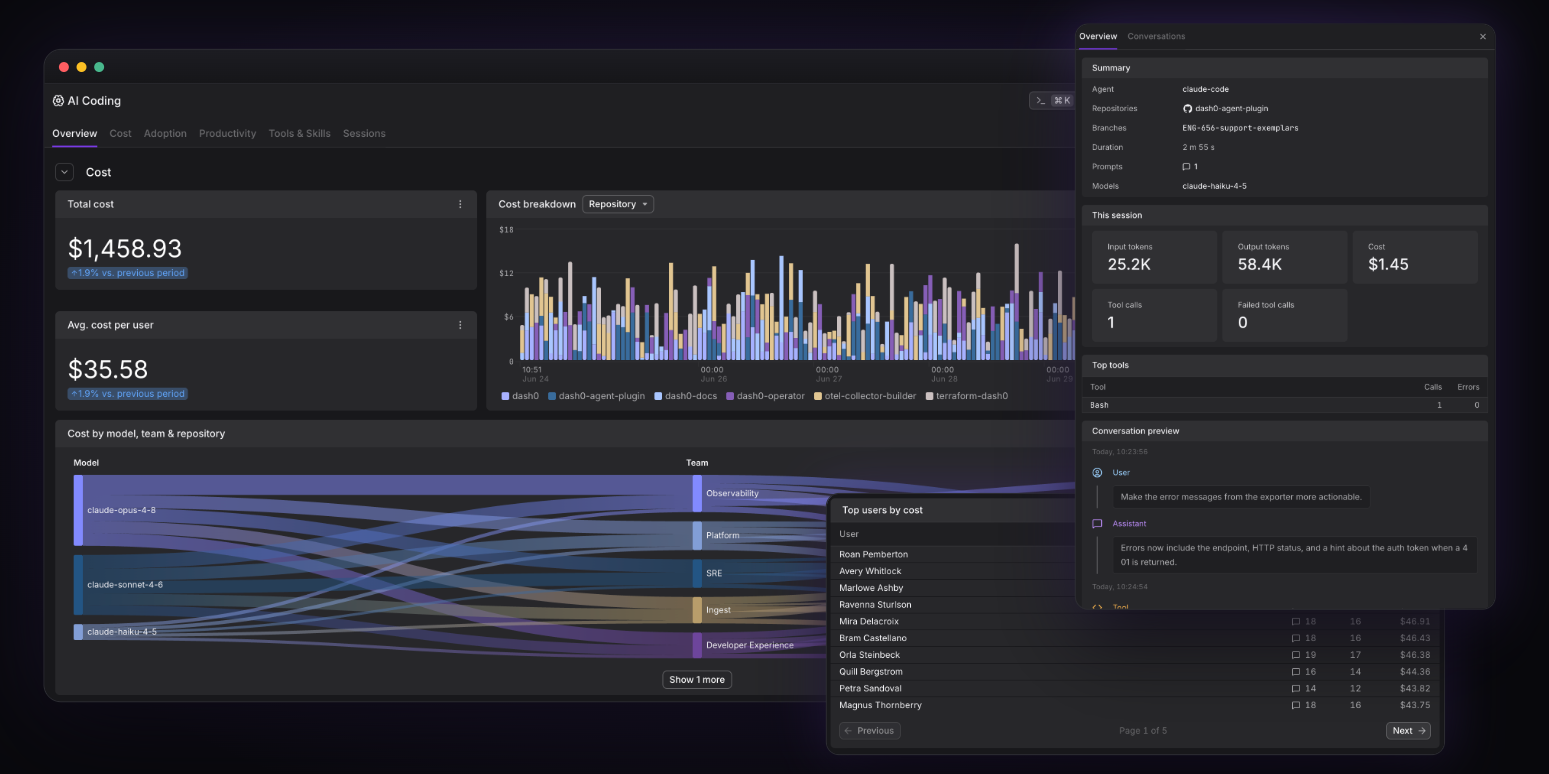
Today, that starts with AI Coding Insights: what AI coding costs across your org, and how much of that output your team keeps. Darkplane observes the coding agents themselves: sessions, token usage, cost, and tool calls. Every session is tied to the repo and branch it works in, so when a pull request shows up, the spend behind it comes attached. Nobody is joining a billing export against GitHub activity after the fact and hoping the names and timestamps line up. Sessions that never turn into a pull request count as well. That exploration is part of the bill. The same link runs forward. When an incident fires, Darkplane already knows which changes went out just before. The search narrows to a short list of candidates instead of a guessing game. The changes that run clean get counted too. That record is what AutoMerge runs on.
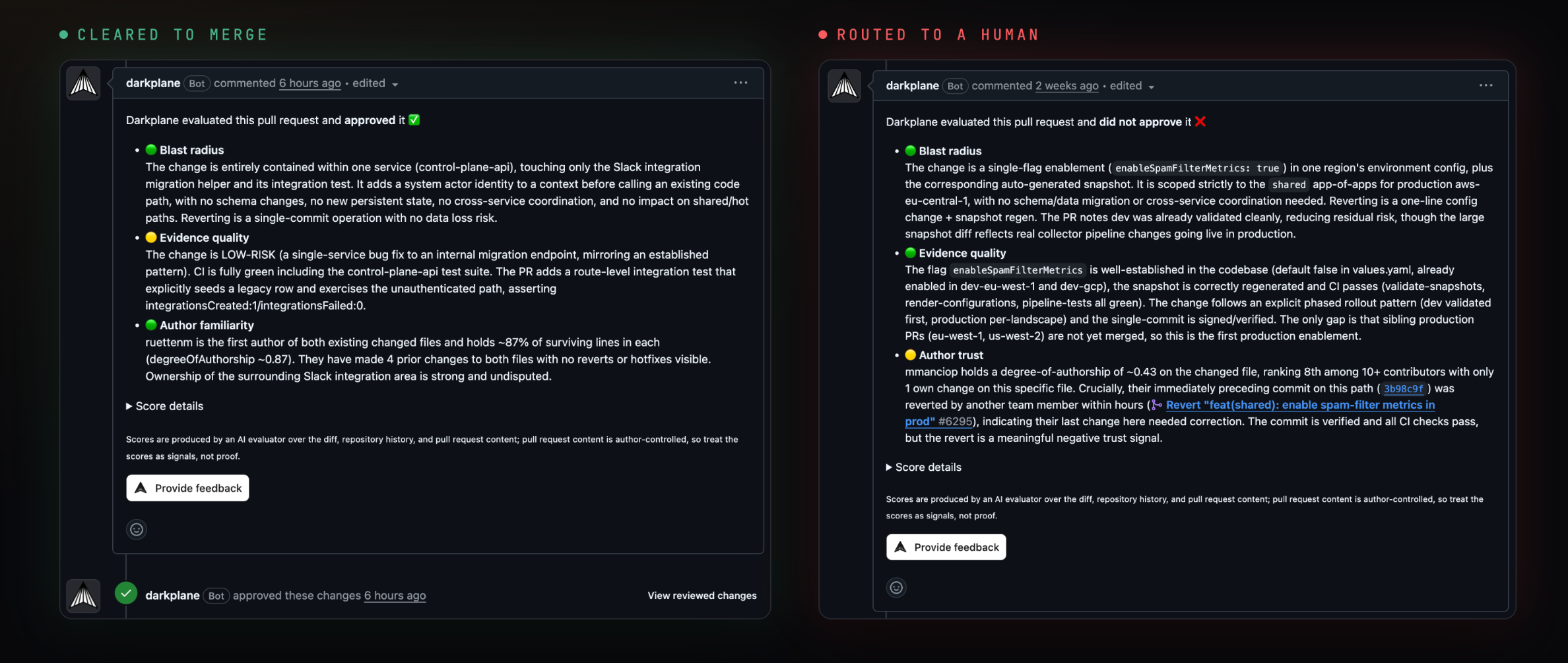
AutoMerge, coming next, takes what your checks and review agents already know about a change and decides what AI ships on its own. The small, safe changes you'd only ever wave through get cleared. Everything else goes to a person. Most auto-approval today runs on static rules: always clear dependency bumps, never touch anything else. But the risk of a change depends on when it lands. The same change is safe to clear while your error budget is healthy and the author has a strong track record. When production is already broken, or the files it touches were reverted last week, it deserves a second look. AutoMerge weighs that live context, plus the change type's track record, and adjusts how much it clears, inside limits you set. When a change type that has been running clean starts causing incidents, it goes back in front of a human. Admittedly, we are still learning where that line sits. Getting this reliable is the real challenge. That's why AutoMerge starts conservative and widens only as change types earn it in production.
Where Darkplane fits
Dash0 started in observability, so we already watch production. Agent0, our AI SRE agent, investigates and fixes what your AI runs there. Darkplane is the other half: what your AI builds before it reaches production. All of it runs on SignalStore, our OpenTelemetry-native data layer, so humans and agents work off the same data. No existing tool sets org-wide policy for what AI can do unattended. That's the part we're building. Start for free at dash0.com/sign-up, or book a demo and we'll look at what your coding agents are costing you.