Technology
Google Cloud Run
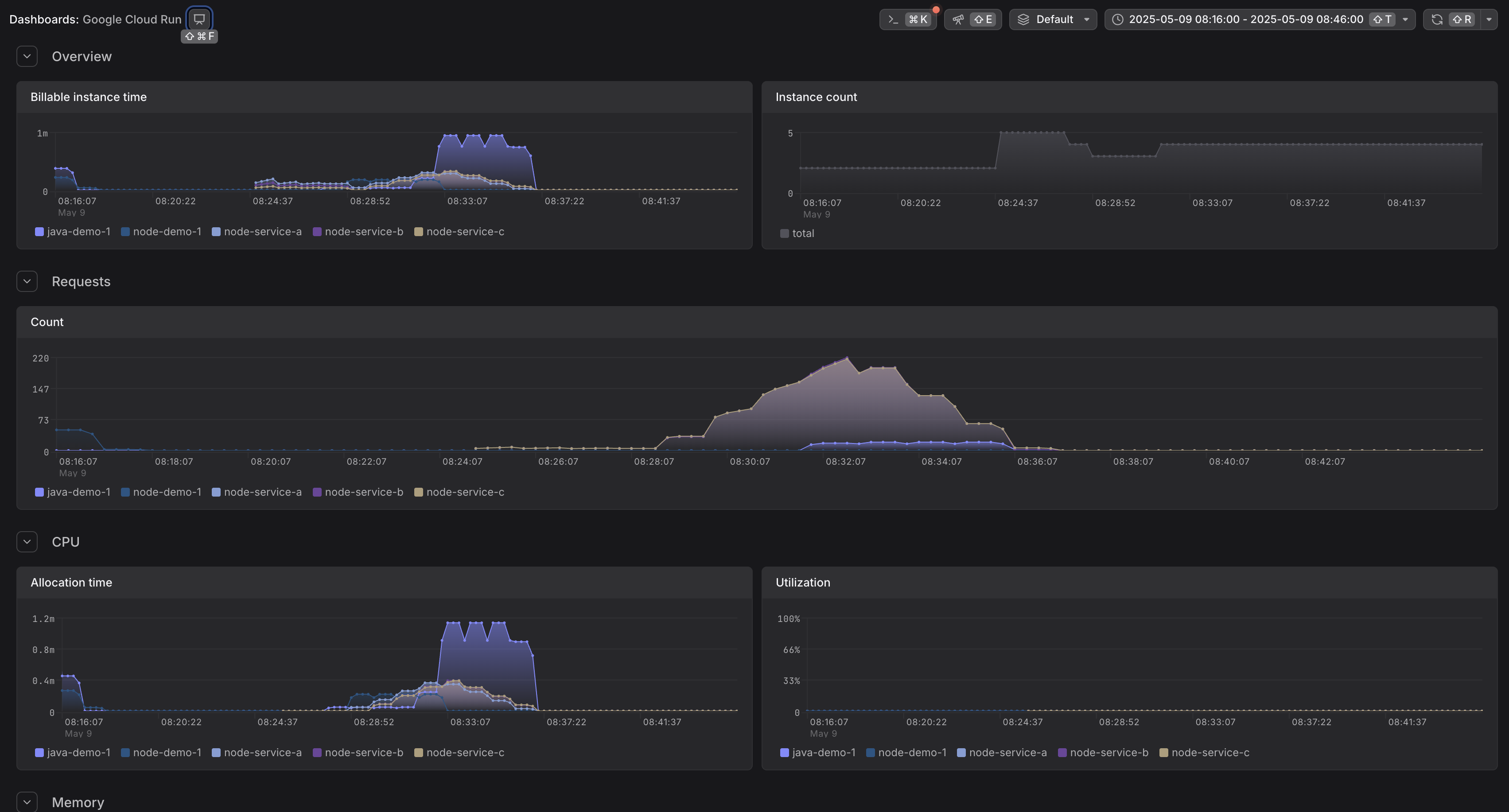
Dash0 integrates with Google Cloud Run by fetching service-level metrics from Google Cloud Monitoring, enabling insight into request performance, concurrency, and resource utilization.
Overview
Overview
Google Cloud Run is a fully managed compute platform that automatically scales your stateless containers. Cloud Run emits several service-level metrics directly to Google Cloud Monitoring, including request counts, response latencies, container resource usage, and concurrency.
This integration helps you collect Cloud Run platform metrics using the OpenTelemetry Collector's googlecloudmonitoring receiver.
Use Cases
- Track request count and latency for each Cloud Run service.
- Monitor container concurrency and resource utilization.
- Capture error responses across Cloud Run revisions.
Metrics Summary
| Metric Name | Description |
|---|---|
run.googleapis.com/request_count | Number of requests received |
run.googleapis.com/request_latencies | Latency of responses |
run.googleapis.com/container/cpu/utilizations | CPU usage by container |
run.googleapis.com/container/memory/utilizations | Memory usage by container |
run.googleapis.com/container/instance_count | Number of container instances |
run.googleapis.com/container/billable_instance_time | Time the container was active (billable) |
run.googleapis.com/container/max_request_concurrencies | Max concurrency of requests handled |
run.googleapis.com/container/network/received_bytes_count | Received bytes |
run.googleapis.com/container/network/sent_bytes_count | Sent bytes |
See Cloud Run metrics in GCP Monitoring for the full list and definitions.
Setup
Setup
Cloud Run metrics are available in Google Cloud Monitoring. To collect these metrics and send them to Dash0, use the OpenTelemetry Collector with the googlecloudmonitoring receiver.
1. Where to Run the Collector
You can run the OpenTelemetry Collector in a few different environments:
- If you're already using Kubernetes, consider deploying the Collector in your cluster.
- Alternatively, you can run the Collector on a standalone VM or Compute Engine instance.
2. Permissions
To collect metrics from Google Cloud Monitoring, the OpenTelemetry Collector must authenticate with the correct permissions and run in a properly configured GCP project.
Required Permissions
The Collector must use a Google Cloud service account with the following role:
roles/monitoring.viewer— grants read access to Cloud Monitoring metrics.
You can assign this role directly to a service account or via Workload Identity if running on GKE.
Authentication
The googlecloudmonitoring receiver uses Application Default Credentials (ADC) to authenticate.
The behavior depends on where you run the Collector:
- On GCP (GKE, Compute Engine): Credentials are picked up automatically from the attached service account — no need to set environment variables.
- Outside GCP (e.g., on a VM or local environment): You must set the
GOOGLE_APPLICATION_CREDENTIALSenvironment variable to point to a service account key file.
Wherever possible, prefer using GCP-native authentication mechanisms like Workload Identity over key files.
Running on GKE? Use Workload Identity
To bind a Kubernetes service account (KSA) to a GCP service account:
- Enable Workload Identity on your GKE cluster (enabled by default on Autopilot).
- Annotate your KSA with the email of the GCP service account.
- Ensure the GCP service account trusts the KSA via the
roles/iam.workloadIdentityUserbinding.
See Workload Identity docs for full setup details.
GCP Project Requirements
Make sure the project you're collecting metrics from meets the following:
- Billing is enabled — required for Cloud Monitoring to function beyond the free tier.
- Cloud Monitoring API is enabled — the collector depends on this to fetch metrics.
- Relevant metrics exist — the metrics you request must be emitted by services running in that project.
If you're not seeing expected data, check that the service is deployed and actively generating telemetry in the target project.
3. Collector Configuration
Replace the <YOUR_GCP_PROJECT_ID> with your GCP project id. Dash0 GRPC endpoint and token can be obtained in the organization settings for your account under "Auth Tokens" and "Endpoints".
receivers:
  googlecloudmonitoring:
    collection_interval: 1m
    project_id: <YOUR_GCP_PROJECT_ID>
    metrics_list:
      - metric_name: "run.googleapis.com/container/billable_instance_time"
      - metric_name: "run.googleapis.com/container/cpu/allocation_time"
      - metric_name: "run.googleapis.com/container/cpu/utilizations"
      - metric_name: "run.googleapis.com/container/memory/allocation_time"
      - metric_name: "run.googleapis.com/container/memory/utilizations"
      - metric_name: "run.googleapis.com/container/instance_count"
      - metric_name: "run.googleapis.com/container/max_request_concurrencies"
      - metric_name: "run.googleapis.com/container/network/received_bytes_count"
      - metric_name: "run.googleapis.com/container/network/sent_bytes_count"
      - metric_name: "run.googleapis.com/request_count"

exporters:
  otlp/dash0:
    endpoint: {{endpoint_otlp_grpc_hostname}}:{{endpoint_otlp_grpc_port}}
    auth:
      authenticator: bearertokenauth/dash0

extensions:
  bearertokenauth/dash0:
    scheme: Bearer
    token: ${token}

processors:
  deltatocumulative:

service:
  extensions: [bearertokenauth/dash0]
  pipelines:
    metrics:
      receivers: [googlecloudmonitoring]
      processors: [deltatocumulative]
      exporters: [otlp/dash0]
4. Further Reading
Dashboards
Cloud Run
Visualize Cloud Run metrics